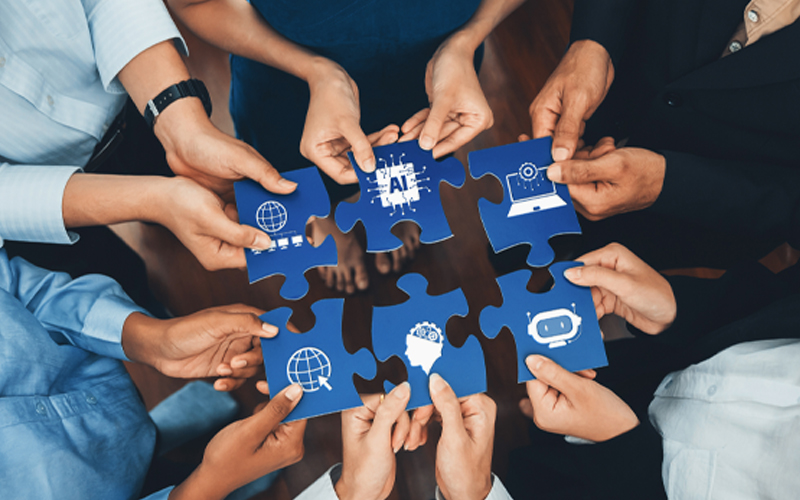



The impact of AI on society represents a dual force in business transformation: while it drives unprecedented efficiency and innovation, it simultaneously challenges the social fabric through workforce displacement, algorithmic bias, and the erosion of digital privacy. The fear that smart machines powered by AI technologies might replace human workers has been rife for years. It has become a reality to some extent in industries that depend on repetitive work, primarily due to advancements in AI systems and machine learning. Loss of work could lead to many unwanted situations, besides economic loss. There are growing fears that data could be abused, humans could lose control over data, socio-economic balance could be at risk, and new kinds of crimes could emerge. Despite the doomsday scenarios predicted, experts agree that AI can help solve many global challenges. Global leaders must come together and set up checks and balances such that the use of AI cannot create any malicious upheavals.
- How Job Automation Affects Unemployment Rates:
- Algorithmic Bias and Socio-Economic Inequality:
- Data Sovereignty: Abuse of Data and Loss of Control:
- The Impact of Deepfakes on Digital Trust and Security:
- How Algorithmic Trading Affects Global Financial Stability :
- The Erosion of Cognitive and Social Skills:
Most of the automatable work can be done by AI. These will largely be repetitive tasks that can be automated through the use of AI. As it happens, the disruption has already started. The dependence on AI-powered machines is already a reality. Lower-wage jobs are at the highest risk. Medicine, law, and accounting are other areas very likely to be affected by the problems with AI. While AI is expected to increase efficiency and save time, the loss of jobs will have a huge impact on the social fabric.
The rise in unemployment will naturally create socio-economic inequality. but the development of AI can create different kinds of biases too. Many senior technologists have expressed the fear that since humans develop AI, human biases will creep into the ethical considerations of AI. We live in mostly homogeneous societies, and it is difficult to think beyond certain boundaries. The ability to create algorithms that can tackle worldwide issues will require an understanding of social dynamics beyond one’s geographical limitations.
Abuse of data is a huge possibility since both data and AI tools are in the hands of a select few. Unless values and ethics are built into digital systems, decisions made by AI algorithms will favour only selected parties , raising significant ethical implications. Privacy and power are being handed over to digital tools over which very few people have any control.
Malicious AI could threaten digital, physical, and political security. For example, people could train machines to hack victims in various ways, weaponize consumer drones, automate unfavourable campaigns for political reasons or implement privacy-eliminating surveillance programmes.
Audio and video deepfakes are already gaining ground. Video deepfakes are being successfully used in the advertising world, making it difficult to differentiate between real and virtual. Social media personalities could be easily engineered to influence sections of society. Similarly, audio clips of influential people can be manipulated and misused.
The next trigger for a financial crisis could be algorithmic trading , which heavily relies on AI and automation. This is the kind of trading that computers would execute based on pre-programmed instructions. Unencumbered by emotions or human instincts, computers could create financial instability by making high-value, high-volume and high-frequency trades.
While AI is expected to augment human capacities, there is fear that increasing dependence on machine-driven networks will reduce our capacity for independent thinking, our social skills, and our ability to take decisions without an automated system. These concerns are part of broader AI social issues that could disturb traditional socio-political frameworks are likely to be disturbed. There could also be the growth of autonomous military applications, the use of AI technologies in weaponised information and propaganda that could destabilise humanity.
Reducing the Risks of Generative AI through Governance
Effective regulations can mitigate the reasons why AI is bad for society by preventing its harmful applications in the future. While research cannot be stopped, regulations can control the implementation of harmful AI technologies to mitigate their negative impact. Human relevance must not be compromised while promoting programmed intelligence.
* For organizations on the digital transformation journey, agility is key in responding to a rapidly changing technology and business landscape. Now more than ever, it is crucial to deliver and exceed on organizational expectations with a robust digital mindset backed by innovation. Enabling businesses to sense, learn, respond, and evolve like a living organism, will be imperative for business excellence going forward. A comprehensive, yet modular suite of services is doing exactly that. Equipping organizations with intuitive decision-making automatically at scale, actionable insights based on real-time solutions, anytime/anywhere experience, and in-depth data visibility across functions leading to hyper-productivity, Live Enterprise is building connected organizations that are innovating collaboratively for the future.
Frequently Asked Questions
How does artificial intelligence impact the global social fabric?
The impact of AI on the social fabric is a dual force; it drives unprecedented efficiency and economic growth while simultaneously challenging traditional societal structures. Key risks include workforce displacement through automation, the erosion of digital trust via deepfakes, and the potential for increased socioeconomic inequality driven by algorithmic bias.
Can algorithmic trading cause a global financial crisis?
Yes, algorithmic trading poses a systemic risk to financial stability. Because these AI-driven systems execute high-frequency and high-volume trades based on pre-programmed instructions without human instinct, they can trigger rapid market volatility and "flash crashes" that outpace the ability of human regulators to intervene.
What are the main ethical risks of algorithmic bias in AI?
Algorithmic bias occurs when human prejudices are unintentionally embedded into AI training models. This can lead to discriminatory outcomes in high-stakes areas like hiring, credit underwriting, and law enforcement. Without diverse datasets and ethical governance, AI risks exacerbating existing socioeconomic gaps rather than closing them.
How do deepfakes threaten digital security and trust?
Deepfakes utilize generative AI to create hyper-realistic audio and video, making it difficult to differentiate between authentic and virtual content. This technology threatens digital security by enabling sophisticated phishing attacks, spreading state-sponsored propaganda, and manipulating public perception through the engineering of influential digital personalities.
What is the concept of Data Sovereignty in the age of AI?
Data Sovereignty refers to the ethical and legal rights of individuals and organizations to maintain control over their data. In an AI-driven society, the concentration of data in the hands of a few tech entities risks the loss of human agency, making transparent values and robust data privacy frameworks essential.