


Supply Chain
Service parts management: Challenges and opportunities
Massive volumes of parts, numerous locations and order lines, and high demand volatility: it’s remarkable that the service parts supply chain has these unique characteristics and is often the ‘forgotten supply chain’.
As businesses expand, managing outsourced products and service parts value chain has gained significance. While businesses continue to update their processes and control costs, finance and service functions have suffered. The reasons range from erratic demand due to unscheduled maintenance events to limited supply chain visibility.
Besides, many businesses are yet to divest themselves of outdated, laborious processes that compromise capabilities to manage customer service-level agreements (SLAs) and costs.
What is service parts management?
Service parts management, also called spare parts management, is the planning, sourcing, stocking and delivery of the replacement parts a business needs to repair and maintain products after the sale. It sits within the after-sales supply chain and aims to have the right part in the right place when a customer or engineer needs it, without tying up too much cash in inventory.
It differs from production supply chains: demand is intermittent and hard to predict, parts may be needed for products sold many years ago, and a missing low-cost part can stop a high-value machine.
Challenges in after-sales supply chain management
When a business is launching a new product in the market, its entire focus shifts towards successfully executing the launch. Production teams work tirelessly to meet the demand, and the logistics department works round the clock to ensure smooth distribution.
However, when it comes to service parts and spares, businesses need a flexible and responsive after-sales supply chain management to drive value from their service parts business.
Some of the challenges businesses face are:
Service parts planning, procurement, and warehousing
Service parts planning means creating distribution flows, managing inventory, monitoring supply, planning distribution logistics, and handling internal assembly and external procurement. Intermittent demand and long part lifecycles make forecasts far less reliable than for finished goods.
Order processing and fulfillment
Monitoring order fulfillment, manage operations, and processing claims and returns quickly, often against tight service-level commitments.
Service parts supply chain analytics
Without analytics, it is hard to track the performance of the supplier, operations, finance, and other relevant areas of business, or to connect sales, service parts and finance systems.
Supply chains are often not as streamlined and efficient as businesses like them to be. A key challenge for businesses that rely on labour-intensive and manual processes is how to manage customer SLAs while achieving savings.

For businesses that fall short on these fronts, opportunities for improving service and productivity lie in factors such as:
- Separate supply chains: Separating the product-level and after-sales service supply chains.
- Better forecasts: Improving demand prediction accuracy (forecasting and preempting the demand for spare parts).
- Spare parts inventory management: Optimising the service parts inventory according to the demand forecast.
- Distribution: Streamlining the service parts distribution and delivery channels across locations.
- Total cost view: Accounting for the costs, demand, lead time, stocking, and delivery aspects.
- Replenishment: Creating optimal replenishment strategies based on the demand predicted.
- Planning model: Centralising or decentralising planning to achieve the desired service levels.
Service parts management needs a dedicated set of processes, skills, and technology to deliver business transformation. It’s time businesses treat service parts as a significant entity rather than considering it as a secondary segment of manufacturing operations. For the stock side, see our guides to inventory management in supply chain management and MRO inventory.
What should a service parts management system do?
Efficient service parts planning and management is the need of the hour.
A holistic solution requires a comprehensive approach towards performance predictability and cost controls that identifies the service parts value chain as a significant business function.
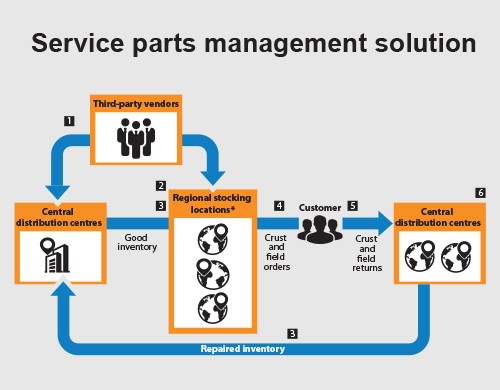
Ideally, here’s what a robust and future-sensitive service parts management solution should enable businesses to do:
- Augment service levels, meet demands, and deliver a remarkable customer experience by automating and supporting customer service and relationship management.
- Implement a dependable system to derive real-time insights that can be used to proactively manage and fulfill customer SLAs.
- Determine demand patterns for service and spare parts using business intelligence and analytics platforms.
- Take complete control of stock levels and ensure that partners and distributors are equipped to handle the surge in demand in regional stocking locations.
- Optimise operations and reduce costs in planning, procurement, logistics, client servicing, and inventory control.
- Improve supply chain visibility across processes and geographies and enhance operations with suppliers and other partners.
- Expedite high-priority orders and monitor third-party repair order completion.
And there’s more: businesses need to monitor shipments and replenishment orders, eliminate silos, track internal parts transfers. A good system also helps businesses to manage return merchandise authorisation (RMA) efficiently. Additionally, a well-established RMA process will promote business consistency and efficiency, as well as deliver adept customer service.
In many cases, businesses will need to evaluate a value-driven blend of solutions and outsourcing strategies that can relieve internal teams and improve efficiencies.
This could include world-class service performance management (SPM) skills training programs and implementation, AI-based software that models spare part demand behaviour, and preconfigured platforms and strategic partnerships to increase the number of deployment options.
With growing customer expectations and increasing costs across the board, organisations must invest in a comprehensive service parts management solution that ticks all the boxes.
How can Infosys BPM help with service parts management?
Infosys BPM’s after-sales services cover service parts management, MRO inventory optimisation, warranty management and service revenue management. For a Fortune 500 construction and mining equipment maker, Infosys BPM restructured warranty and claims operations and cut claim closure time from 15 days to under 10 days, with a centralised, round-the-clock support model.
Frequently asked questions
What is the difference between service parts and spare parts?
The terms are often used interchangeably. Service parts usually refers to parts a manufacturer supplies to support its products in the field, while spare parts often describes parts a company keeps to maintain its own equipment.
Which KPIs matter most in service parts management?
Common measures are fill rate or first-time parts availability, inventory turns, backorder age, emergency shipment costs and the cost of obsolete stock. Tracking them by part class shows where to rebalance inventory.
How do you manage critical spare parts with very low demand?
Classify parts by criticality and demand pattern, hold insurance stock for parts whose absence would stop key equipment, pool stock across locations, and use supplier agreements or 3D printing for parts with long lead times.
When should a company outsource service parts management?
Outsourcing helps when service levels keep slipping, parts operations span many regions or partners, or internal teams lack planning and analytics skills. Most companies keep strategy in-house and outsource planning, order management and reporting.