


DIGITAL INTERACTIVE SERVICES
What are AR and VR in digital marketing, and how are they reshaping it?
Customers now expect to see, try and place a product before they buy it, even when the purchase happens on a phone. Augmented reality (AR) and virtual reality (VR) in digital marketing are how brands meet that expectation: AR layers digital content over the real world through a smartphone camera or smart glasses, while VR places the customer inside a fully digital environment through a headset or a 360-degree video.
These technologies have enabled digital marketers to enhance customer experience by providing them with real-life shopping experiences from the comfort of their homes. This blog explains what AR and VR mean in marketing, how the two differ, six ways they are reshaping digital marketing, how to get started, and how to measure the results.
What is AR and VR in marketing?
AR and VR are terms that are often used interchangeably. However, there is a difference between these technologies, and they have specific capabilities that can be leveraged by digital marketers.
AR is a technology that provides a unique customer experience by just tapping into a smartphone. It helps customers try different products virtually before they purchase them. VR helps provide buyers with a digital experience that is close to a real-life experience. Together with mixed reality, the two are grouped under extended reality (XR), so "XR marketing" in an agency or platform brief means any campaign that uses one or more of these formats.
| Augmented reality (AR) | Virtual reality (VR) | |
| What the customer sees | Digital objects, filters or information layered over their real surroundings | A fully digital environment that replaces their surroundings |
| Device needed | A smartphone or tablet camera; smart glasses optional | A VR headset for full immersion; 360-degree video works in a browser |
| Typical marketing use | Virtual try-on, furniture placement, packaging that comes alive, social media lenses | Virtual showrooms, test drives, venue and property tours, brand storytelling |
| Best for | Reach: anyone with a phone can take part | Depth: a small audience gets a memorable, high-attention experience |
| Where it sits in the funnel | Consideration and purchase | Awareness and consideration |
Examples of AR and VR in marketing
In a customer-centric marketing approach, customer satisfaction is one of the main focus areas for digital marketers. AR and VR technologies are currently being deployed by some of the top brands like Starbucks, MAC, L’Oreal, Audi and many more!
Makeup brands like MAC and L’Oreal leverage AR to enable buyers to try on the makeup virtually before they buy it. AR is used by furniture brands like IKEA to help buyers place furniture items in the layout of their homes. This gives them an idea of how the furniture will blend with their interiors.
Car manufacturers provide a virtual car showroom experience with VR, which also facilitates test drives for buyers. Starbucks offers a virtual experience where customers can enjoy a cup of coffee in a location of their choice.
These are some examples of how VR and AR are revolutionising traditional marketing techniques. Besides these, there are many other ways in which these technologies bridge the gap between customer experience and action. The audience is already comfortable with the hardware: a Pew Research Center survey found that 24% of US teens play video games on a VR headset, and that cohort is the next decade’s buyer.
Six ways AR and VR are reshaping digital marketing
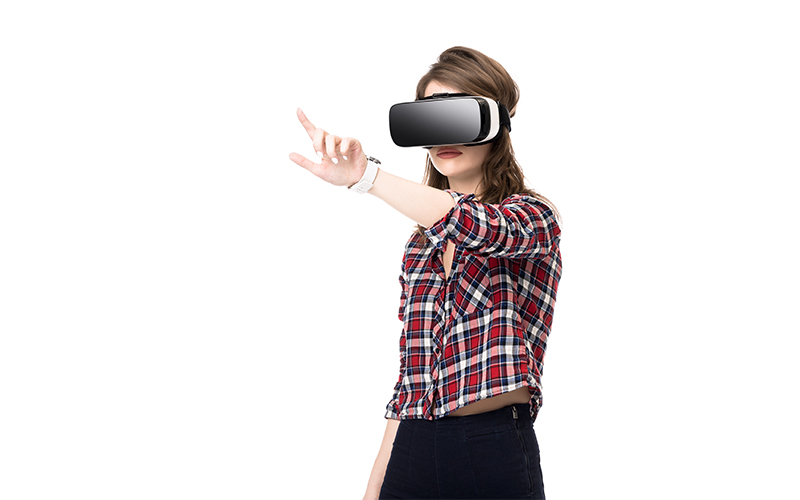
-
Provide an immersive and interactive environment for users
VR provides a rich and engaging experience to buyers. AR helps users with a “try before you buy” experience from the comfort of their homes. VR virtually transports the user into a different environment. This is the core of immersive marketing: the customer takes part in the brand experience instead of watching it. -
Offer personalised content to consumers
Every digital marketer strives to offer a personalised buying experience to its consumers. AR and VR technologies are highly effective in facilitating this. They allow consumers to experience content at a deeper level, from a first-person perspective. Content that is personalised to buyers’ needs is adopted faster. -
Are effective media for storytelling
One of the most effective ways to establish a connection with the audience is storytelling. Both AR and VR help bring stories to life and engage users. For instance, in the National Geographic AR app, the brand communicates the experience of climbing a mountain through storytelling and technology helps the user feel as if he is a part of the exercise. -
Improve brand awareness
VR and AR apps help create a buzz about a brand because they make it easy for users to share their experiences on social networks. It helps spread the word about the brand, thereby reaching a wider audience. -
Impact buying decisions
AR and VR technologies provide consumers with a great shopping experience. This draws them back to the brand for more. Thus, these technologies not only increase brand awareness but also help in customer retention. -
Provide in-depth analytics
In a highly dynamic marketplace, digital marketers need accurate data analytics to build marketing strategies. AR and VR solutions integrate web analytics and social media analytics, thereby providing valuable marketing insights at a single source. Besides, AR and VR are intuitive technologies, and they offer specific information regarding consumer behaviour.
How to start with AR and VR in digital marketing
Most failed immersive campaigns fail on planning, not technology. Five steps keep the first project small and measurable:
- Start with one business objective. Fewer returns, a higher add-to-cart rate, more time on a product page or more event leads. The objective decides whether AR or VR is the right format and what "success" means at the end.
- Choose the format by audience reach. If the audience is broad and mobile, AR on the smartphone camera wins. If the audience is narrow and high value, such as dealers, B2B buyers or event visitors, a VR experience is worth the smaller reach.
- Use platform-native tools before custom builds. Social media lens and filter tools, web-based AR viewers and 360-degree video players run without an app download and can be live in weeks. Custom apps come later, once the format has proved itself.
- Build the asset pipeline. Immersive campaigns run on 3D product models, product data and video. Setting up how those assets are produced, approved and localised is the part that decides whether the second campaign is faster than the first.
- Test, measure and then scale. Run the experience with a small audience, compare its results with the same campaign without the immersive layer, and expand only the formats that moved the original objective.
What are the challenges of AR and VR in marketing?
Three issues come up in almost every programme:
- Device reach: AR reaches anyone with a phone, but full VR still depends on headset ownership, so VR campaigns need a browser-based fallback such as 360-degree video.
- Content cost and upkeep: every product variant needs a production-quality 3D model, and models go stale as ranges change, so the asset pipeline matters more than the campaign creative.
- Measurement: standard web analytics do not capture what happens inside an AR or VR experience, so the campaign needs its own metrics from day one, which the next section covers.
How do you measure AR and VR marketing results?
AR advertising now has an industry measurement standard: the Interactive Advertising Bureau (IAB) and the Media Rating Council (MRC) published the Augmented Reality Measurement Guidelines in April 2024, which define how AR ad delivery, viewability and audience are counted so that AR results can be compared with other digital formats. [11.1]In practice, marketers track five things: how many people opened the experience, how long they stayed in it and what they interacted with, how many shared it, what share went on to add to cart, book a demo or visit a store, and, for try-on and placement formats, whether product returns fell. Comparing those numbers with the same campaign minus the immersive layer is the only clean way to prove the format paid for itself.
In conclusion
Digital transformation remains a chief focus area for businesses, and immersive formats are now part of it. Technologies such as RPA, AI, ML, VR/AR, etc. are being widely adopted. AR and VR technologies impact end-to-end digital marketing and can become effective tools for building marketing strategies. They help identify the target audience, understand buying behaviours and create customised buying experiences. AR and VR are cost-effective marketing tools that facilitate profiling target audiences and offer them a customised experience.
How can Infosys BPM help?
Infosys BPM’s digital interactive services practice runs marketing operations end to end, from campaign and community management to CRM and content management system (CMS) operations, e-commerce and event operations. Its in-house Digital Studio produces video, creative adaptations and content at scale, which is where AR, VR and 3D assets are built, localised and kept current across markets, so the immersive layer of a campaign is produced with the same discipline as the rest of it.
Frequently asked questions
How do AR and VR work in social media marketing?
On social platforms, AR usually arrives as a sponsored lens or filter: the customer opens the camera, tries the product or plays with a branded effect, and shares the result, so the brand’s reach grows through the customer’s own network rather than through paid impressions alone. VR on social media is mostly 360-degree video and live virtual events that can be watched in a feed without a headset. The practical rule is to build for the platform’s native camera tools first, because that is where the audience already is.
What is the role of AR and VR in B2B marketing?
In business-to-business (B2B) marketing, AR and VR replace the physical product demonstration. A buyer can walk through a factory line, a data centre or a piece of industrial equipment in VR from their desk, or point a tablet at a site and see the proposed installation in AR. Trade-show stands, technical training content and after-sales guides all reuse the same 3D assets, which is why B2B teams treat immersive content as part of the content pipeline rather than a one-off campaign.
How do brands add AR and VR to campaigns that are already running?
The fastest route is to attach an immersive layer to an existing channel instead of launching a separate campaign: a QR code on packaging or print that opens a web AR try-on, a lens added to a social campaign already in flight, a 360-degree walkthrough embedded in an email or landing page, or a VR demo added to an event stand. Because these formats reuse existing product images, 3D models and customer relationship management (CRM) data, they can go live in weeks and be measured against the same objectives as the parent campaign.
How much does an AR or VR marketing campaign cost?
Cost depends on the format more than the technology. A platform-native filter or lens built with free creator tools sits at the low end; a web-based AR try-on or product visualiser costs more because it needs production-quality 3D models of every variant; a custom AR app or a full VR experience sits at the top because it needs software development, headset testing and ongoing maintenance. The main cost drivers are the number of products to model, the level of realism required, and how many platforms and devices the experience has to support.