
AI in customer service is moving beyond simple question answering into multi-step customer-service workflows, including account updates, status checks, and other policy-governed actions. As enterprises expand their use, the value will depend not simply on how much work AI can automate, but on how deliberately organisations allocate work between AI and human agents.
AI agents for customer service can provide speed and scale for defined workflows, while human-AI collaboration allows human agents to bring judgement, empathy, and discretion where they matter most. The objective is to embed AI into the operating model rather than layer it onto an unchanged contact centre.
Why AI agents alone are not a customer service strategy
AI agents are well suited to high-volume, repeatable work where policies are clear, the required data is available, and the permitted actions are well defined. Human agents add greater value when a case requires contextual judgement, discretion, or sensitivity.
The important question is therefore not simply whether an interaction is routine or complex. It is whether the organisation has defined the decision rights, safeguards, and escalation paths needed to resolve it safely.
The goal is not to automate as many interactions as possible. It is to match each interaction to the right combination of AI capability and human judgement. That means looking beyond task complexity to factors such as risk, policy clarity, data availability, and the consequences of getting the decision wrong.
Which interactions should AI agents handle?
Whether an interaction is straightforward or complex, the most useful test is whether an AI agent can resolve it safely within defined policies, available data, and an acceptable level of risk.
AI agents for customer service can effectively handle:
- Account and transaction management
- Routine service requests
- Information requests
Human agents should generally lead when interactions involve:
- Sensitive or disputed cases
- Complex or exceptional cases
- High-risk decisions
The practical dividing line is not complexity alone. It is whether the AI agent has the authority, information, and safeguards required to resolve the interaction without unacceptable risk. When those conditions are not met, the operating model should route the interaction to a human rather than forcing AI to complete it.
How to design a human-AI collaboration model for your contact centre
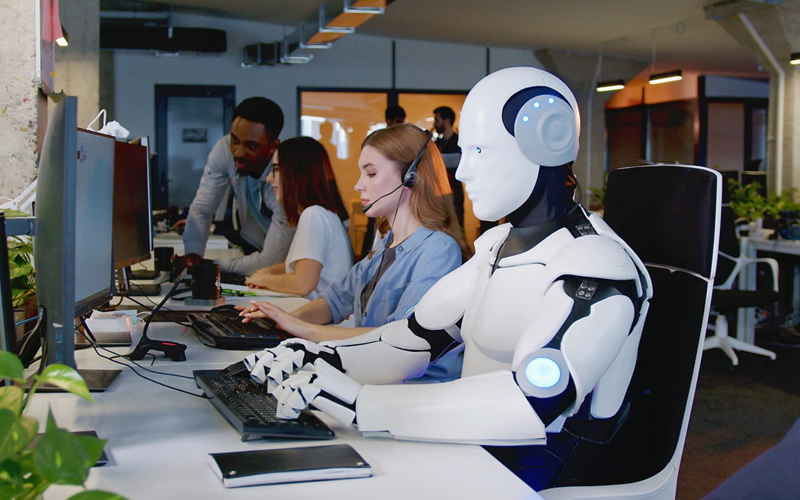
The gap between deploying AI and operationalising it remains significant. A 2025 McKinsey study found that half of organisations are still stuck in the pilot stage, while 80% are uncomfortable running end-to-end operations. Organisations need to define who handles which interactions, when AI must defer to a human, and which actions require human approval.
Decide when work should move to a human
Not every interaction needs the same level of automation. Organisations should define triggers for moving an interaction from AI to a human based on risk, customer sentiment, policy boundaries, uncertainty, and failed resolution attempts.
The handoff should preserve the customer context. Human agents should receive the conversation history, relevant customer information, actions already taken, and reason for escalation.
Set boundaries for what AI can do
AI agents need access to up-to-date, approved knowledge and clear boundaries around what they can retrieve, recommend and execute.
Organisations should define:
- Which knowledge sources AI can access
- Which actions it can perform independently
- Which actions require human approval
- How policy and knowledge changes reach AI workflows
- How AI agents handle conflicting or outdated information
For sensitive or regulated interactions, organisations should also be able to trace the information, policy, or workflow behind an AI response or action and maintain an appropriate audit trail.
Redesign the human role
As AI takes on more transactional work, organisations should redesign the human role around decision-making, exception management, AI oversight, and continuous improvement. This makes the contact centre more than a place where human agents receive escalations; it becomes an environment where people actively supervise and improve the wider service system.
This shift creates new responsibilities:
- Resolve: Handle interactions requiring judgement or discretion
- Supervise: Review AI interactions and intervene when needed
- Improve: Identify recurring issues and refine workflows
- Coach: Identify gaps and edge cases that improve AI performance
- Protect: Oversee sensitive interactions and ensure AI stays within defined boundaries
The result is not simply fewer human interactions, but a different contribution to human-AI collaboration, focused on judgement, oversight, and improvement.
Measure the whole service model
Measuring the performance of AI customer service and human operations should not be a separate exercise. Leaders should assess whether the combined model resolves issues effectively, protects the customer experience, and operates within acceptable risk.
Useful indicators include:
- First-contact resolution: Whether the team resolves the issue on the first contact
- Customer effort and satisfaction: Ease of experience and whether the outcome meets expectations
- Repeat contacts: Whether customers return because the issue was not fully resolved
- Escalation quality: Whether handoffs reach the right human resource at the right time
- Compliance, error, and exception rates: Whether AI and human workflows operate accurately within policy
- Cost per resolved interaction: The overall cost of resolving an issue across AI and human resources
Metrics should reflect the changing mix of work. If AI absorbs routine contacts, human agents may handle a more complex case mix, making longer handling times an expected consequence of the new model rather than necessarily a sign of poorer performance.
How can Infosys BPM help you design the human-AI operating model?
A human-AI operating model requires more than deploying AI agents for customer service. Infosys BPM helps bring these elements together, embedding AI customer service capabilities into customer-service operations while keeping human judgement central to complex and sensitive interactions.
The focus is on designing human-AI collaboration around clear decision rights, effective escalation, and measurable outcomes. This enables AI agents for customer service to handle appropriate workflows while human teams retain responsibility for judgement, exceptions, and sensitive interactions.
Frequently asked questions
Those an AI agent can resolve safely within defined policy, with the data it needs and an acceptable level of risk. In practice that means account and transaction management, routine service requests, and information requests. Complexity alone is not the test; authority, information, and safeguards are.
When the case is sensitive or disputed, exceptional, or carries a high-risk decision, and whenever the AI agent lacks the authority, information, or safeguards to close it. Triggers should be defined in advance against risk, customer sentiment, policy boundaries, uncertainty, and failed resolution attempts.
The role shifts from handling volume to five responsibilities: resolving cases that need judgement, supervising AI interactions, improving workflows, coaching the AI on gaps and edge cases, and protecting sensitive interactions. Average handling time may rise because the remaining case mix is more complex.
Across the combined model rather than separately: first-contact resolution, customer effort and satisfaction, repeat contacts, escalation quality, compliance and error rates, and cost per resolved interaction. Measuring AI in isolation hides whether the handover is working.