



Supply chains are under sustained pressure from volatile demand, geopolitical disruption, and stricter sustainability and compliance requirements. Traditional optimisation models and rule-based automation struggle in this environment, as they rely on static assumptions and delayed data. As AI agents in supply chain operations gain relevance, organisations are beginning to move beyond isolated tools towards more autonomous and resilient supply chain models. This article examines how AI agents are reshaping supply chain operations and enabling greater autonomy and resilience across complex networks.
how AI agents enable autonomous supply chain operations
Earlier AI initiatives in supply chain functions were largely deployed as point solutions, such as demand forecasting or route optimisation tools. While these approaches delivered localised efficiency gains, they offered limited visibility or coordination across the broader supply network. AI agents in supply chain operations address this gap by orchestrating end-to-end workflows, combining real-time operational data, optimisation logic, and contextual inputs to support more autonomous supply chain execution.
For senior finance and operations leaders, this represents a shift from decision support to execution at scale. AI agents can continuously assess trade-offs between cost, service levels, and risk, and act across planning, logistics, and inventory systems within defined governance boundaries. As a result, AI for supply chain resilience becomes a mechanism for protecting margins, improving working capital discipline, and maintaining continuity during periods of disruption. Reflecting this priority, research indicates that 64% of supply chain leaders now view AI and generative AI capabilities as critical when evaluating new technology investments.
building resilience through agentic intelligence
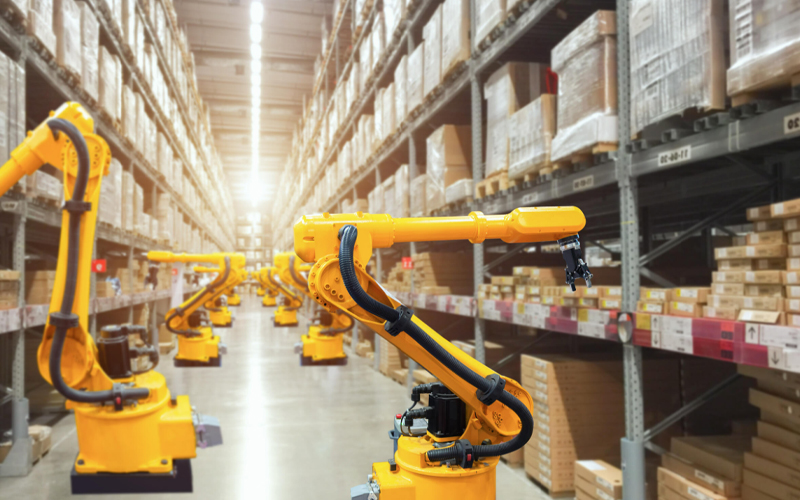
Supply chain resilience has become a leadership-level concern. Disruptions related to geopolitics, climate events, and supplier concentration now occur with greater frequency and impact. AI for supply chain resilience focuses on anticipating risk and responding before disruptions escalate.
Agent-based systems continuously monitor supplier performance, logistics signals, and demand variability. When anomalies arise, agents can simulate alternative scenarios and trigger corrective actions without waiting for manual intervention. Industry research indicates that organisations applying advanced AI-driven automation improve disruption response times significantly compared to traditional planning approaches.
key AI agent use cases in supply chain
There are several AI agent use cases in supply chain that enterprise leaders are piloting and scaling today.
orchestrating logistics and transportation
AI agents analyse live constraints such as capacity, traffic, and service levels, then propose or execute routing changes that reduce expedite costs and shorten order-to-delivery cycles. This reduces expedite costs by 3% – 5% of total logistics spend, which has a direct profit and loss impact.
enabling AI for supply chain resilience
Agents continuously scan for disruption signals, from supplier delays to macro shocks, then simulate scenarios and recommend sourcing or allocation changes that preserve continuity. This helps procurement and risk leads move from static contingency plans to dynamic, scenario-based responses.
automating planning and inventory decisions
By combining large language models with mathematical optimisation, agents can reconcile demand signals, capacity constraints, and business rules, then generate executable production and inventory plans. This reduces manual planning cycles and allows planners to focus on exceptions and cross-functional trade-offs instead of spreadsheet maintenance.
improving warehouse and fulfilment operations
AI agents track inventory positions, task queues, and automation status, then reassign work to remove bottlenecks and protect on-time fulfilment. For operations leaders, this creates a path toward more autonomous supply chain nodes that still operate within governance boundaries.
implementation considerations and governance
Despite their potential, AI agents require careful deployment. Without clear governance, increased autonomy can introduce new operational, financial, and compliance risks. Effective implementation depends on defining decision boundaries, establishing robust data foundations, and ensuring appropriate human oversight so that agentic solutions operate within controlled and accountable frameworks across global supply chains.
effective programmes typically emphasise:
- Defining clear decision boundaries to ensure agents act within approved risk thresholds
- Integrating data responsibly across ERP, planning, and execution platforms
- Maintaining human oversight for high-impact financial or compliance decisions
- Establishing transparent audit trails to support regulatory and internal governance
the future is autonomous supply chains
AI agents in supply chain environments are redefining how organisations manage complexity, risk, and growth. By enabling autonomous decision-making within controlled frameworks, they support resilience, financial discipline, and operational agility.
For leaders evaluating their next steps, the priority lies in understanding where autonomy delivers the greatest value and how it aligns with enterprise governance models. Exploring modern supply chain transformation services can help organisations assess readiness and identify high-impact opportunities without disrupting ongoing operations.
Frequently Asked Question
AI agents orchestrate multi-step workflows across systems, not isolated forecasts or recommendations.
They can sense changes, evaluate trade-offs (cost, service, risk), and then trigger approved actions across planning, logistics, and inventory platforms.
This moves supply chain AI from decision support to governed execution at scale.
Define decision boundaries, enforce human oversight for high-impact actions, and maintain end-to-end audit trails.
A robust data foundation and clear accountability prevent autonomy from creating financial, operational, or compliance exposure.
This enables faster response to disruption without losing control of outcomes.
Start with constrained, high-frequency decisions such as logistics orchestration, exception management, and inventory rebalancing.
These areas benefit from real-time signals and repeatable decision logic, making outcomes measurable through expedite spend reduction, service stability, and working-capital discipline.
This builds a scalable business case before expanding autonomy.