



The mining industry is facing rising pressure to boost efficiency, minimise environmental impact and strengthen worker safety, all while navigating global labour shortages and evolving regulations. AI in mining sits at the heart of mining’s next industrial shift, reshaping extraction, decision-making, and sustainability commitments. The scale of transformation ahead is significant, as Precedence Research AI in mining report projects the market to grow from $35.47 billion in 2025 to nearly $828.33 billion by 2034, at a CAGR of 41.92%. This momentum creates space for a reimagined “intelligent mine” that integrates automation, data-driven insights, and human-machine collaboration.
how AI in mining is revolutionising operations
AI in mining is reshaping how the industry looks at productivity, planning accuracy, and value chain risk management. It also strengthens sustainability commitments as organisations modernise ageing infrastructure and shift to low-impact operations.
exploration intelligence and geological modelling
AI-powered exploration, where machine learning interprets geological datasets to identify probable mineral zones, accelerates discovery and reduces risk. AI tools also increase mining productivity by reducing survey times and increasing drilling accuracy. As a result, teams can direct investment toward higher-potential areas.
drone-based sensing and environmental monitoring
AI-powered drones expand visibility and support environmental compliance. High-resolution mapping helps identify structural risks and terrain instability. Drones also capture environmental indicators for emissions, waste, and water use. These insights help promote sustainable mining with AI technology.
resource optimisation and extraction planning
AI models improve precision and reduce waste across extraction processes. Algorithms optimise blasting patterns, ore grades, and shovel allocation while resource models improve yield forecasting and extraction sequence planning. This results in reduced variance, which leads to higher throughput and lower energy consumption.
autonomous operations and fleet coordination
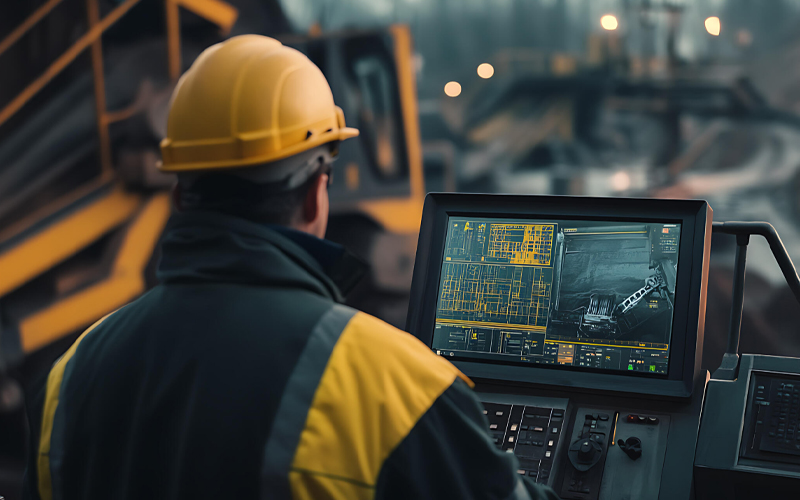
AI-enabled autonomy improves haulage cycles, drilling accuracy, and fleet utilisation. Automated haul trucks and drills maintain steady performance in challenging conditions. Intelligent fleet systems assign workloads, optimise routes, and coordinate equipment. This helps reduce human exposure and enhances mining safety.
predictive maintenance and asset health
Advanced models anticipate component failure and monitor equipment performance. Predictive schedules reduce downtime and extend equipment lifespan. Condition monitoring systems analyse vibration, temperature, and load data, giving maintenance teams real-time insights to prioritise interventions.
safety intelligence and high-risk monitoring
AI-powered mining safety solutions strengthen on-site safety and regulatory compliance. AI tools in mining identify hazards such as geotechnical changes or equipment deviations. Wearables and sensors track worker location, fatigue, and environmental exposure. This continuous oversight lowers incident rates and improves response times.
remote operations and workforce augmentation
Automation supports leaner, safer, and more flexible operations. Remote control centres supervise dispersed sites with integrated data feeds. Skilled teams use AI recommendations to make faster operational decisions. Such human-AI collaboration reduces labour constraints across remote regions and helps improve mining productivity.
data-driven productivity optimisation
AI models improve cycle times, production sequencing, and energy usage. AI-driven processes unify geological, operational, and sensor data to adapt in real time, resulting in compounded productivity gains across planning, extraction, and processing.
integrated platforms and real-time decision systems
Unified data platforms improve collaboration and operational clarity. ERP-integrated AI systems break silos across logistics, processing, and maintenance, supporting real-time decision systems that can perform scenario analysis and offer actionable operational intelligence.
Infosys BPM helps mining organisations accelerate transformation using customised AI solutions across discovery, design, and pilot stages. Its domain expertise, unified platforms, and scalable AI architecture enable mining enterprises to modernise operations and drive measurable productivity, safety, and sustainability gains.
benefits of AI in mining
Organisations adopting AI in mining operations see measurable improvements across safety, efficiency, and environmental performance. These benefits extend across extraction, processing, logistics, and strategic planning, supporting long-term operational resilience.
- Intelligent lighting systems reduce energy consumption and enhance visibility.
- Predictive maintenance cuts downtime and improves asset longevity.
- AI-led exploration increases precision and boosts resource yield.
- Automated workflows reduce operational costs across the value chain.
- Carbon tracking supports smart reclamation and reduces environmental footprint.
- Real-time dashboards improve decision speed and compress decision cycles.
To realise these benefits, mining organisations must balance autonomy with human oversight, ensure fair reward distribution, and address algorithmic bias in risk prioritisation. Transparent AI models strengthen organisational trust and improve acceptance across teams. Ethical adoption goes hand in hand with future trends such as edge and quantum computing, advanced robotics, blockchain-enabled traceability, and workforce transformation centred on human-AI collaboration.
conclusion
AI in mining underpins the industry’s shift toward safer, cleaner, and more resilient operations. Its ability to optimise extraction, cut downtime, and reduce environmental impact positions leaders to build a future-ready mining ecosystem that meets global performance expectations. As adoption accelerates, organisations can reimagine each stage of the value chain with intelligent systems that pair human expertise with powerful, data-driven insight, creating truly intelligent mines capable of thriving in a changing world.
Frequently Asked Question
AI optimises exploration, drilling, blasting, hauling, and processing by analysing geological, sensor, and operational data, which improves yield, reduces waste, and lowers energy consumption.
AI-powered safety systems monitor geotechnical conditions, equipment behaviour, and worker location or fatigue in real time, allowing earlier detection of hazards and faster incident response.
AI-driven drones provide high-resolution mapping and environmental monitoring, while remote operation centres use AI insights to control equipment and coordinate fleets, reducing on-site exposure for workers.
AI helps track emissions, energy usage, and water or waste metrics, optimise resource use, and inform reclamation planning, enabling lower environmental impact and better compliance.
They should focus on unified data platforms, clear safety and sustainability objectives, scalable AI architectures, human–AI collaboration models, and strong governance to manage risk and bias.