
As engineering change accelerates and compliance expectations rise, technical publication authoring has to move beyond manually coordinated, document-centric workflows. Agentic AI introduces a new approach in which intelligent agents work alongside domain experts to assess changes, recommend compliant updates, coordinate reviews, and improve authoring speed, consistency, and governance.
For engineering-led organisations, this transformation is becoming a strategic priority as product complexity, digital thread adoption, and service responsiveness continue to increase.
Agentic AI for technical publications helps to shift technical publications authoring from manual documentation cycles to connected, standards-driven, and intelligence-enabled workflows. Specialised agents can analyse inputs, identify affected content, recommend standards-aligned updates, coordinate approvals, support quality checks, and notify stakeholders through closure.
The documentation challenge: more change, less time, higher quality expectations
Technical publication updates typically begin with an approved engineering change package, including an Engineering Change Request/Notice (ECR/ECN), Service Bulletin (SB), Engineering Order (EO), Airworthiness Directive (AD), design change, new component introduction, functional modification, safety instruction, or correction of an existing error. Change requests may be received through engineering change-management systems, workflow tools, customer/Original Equipment Manufacturer (OEM)/regulatory portals, email, or secure file-transfer channels.
The Technical Publications team reviews the request, validates its completeness, gathers supporting engineering source data, identifies affected models, manuals, tasks, data modules, illustrations, and applicability/effectivity, performs impact analysis, validates the change against approved engineering evidence, authors the required updates, completes technical and quality reviews, obtains the necessary approvals, publishes the revised content, and closes the request with stakeholder notification and traceability records.
In practice, this end-to-end process is often slowed by manual workflows, inconsistent engineering source data, and repeated rework. Maintaining compliance, Simplified Technical English (STE) adherence, and documentation quality across large publication sets adds further complexity. Incomplete or inconsistent updates across manuals can lead to documentation errors, which may impact maintenance readiness, aircraft availability, Aircraft on Ground (AOG) recovery, operational efficiency, cost, safety, regulatory compliance, and ultimately customer confidence and trust.
From manual authoring to AI-orchestrated authoring
Agentic AI changes the authoring equation by combining probabilistic intelligence with deterministic execution. Instead of only generating text, an agentic authoring ecosystem participates across the end-to-end lifecycle: monitoring incoming change requests, analysing requests, validating request completeness, identifying impacted manuals, tasks, data modules, and content areas, recommending standards-compliant and STE-adherent updates, supporting human-in-the-loop review and approval, executing controlled updates in the authoring environment, validating changes against defined business and publication rules, and automatically notifying relevant stakeholders once authoring is complete.
AI agents interpret change requests, identify potentially affected content, and recommend updates, while workflow engines, rules, templates, schemas, and validation services govern routing, authoring, approvals, and publication. This separation keeps repeatable and compliance-sensitive activities predictable, traceable, and auditable.
The image below demonstrates our POV on technology and human collaboration across the end-to-end technical publication authoring process. This creates a human-supervised operating model in which deterministic automation handles repeatable, rules-based, and high-volume activities. AI supports tasks requiring interpretation, semantic analysis, or drafting, while experts retain control over judgment, approvals, and exceptions. The outcome is a governed authoring process that improves speed, consistency, quality, and traceability without relying on unconstrained model output.
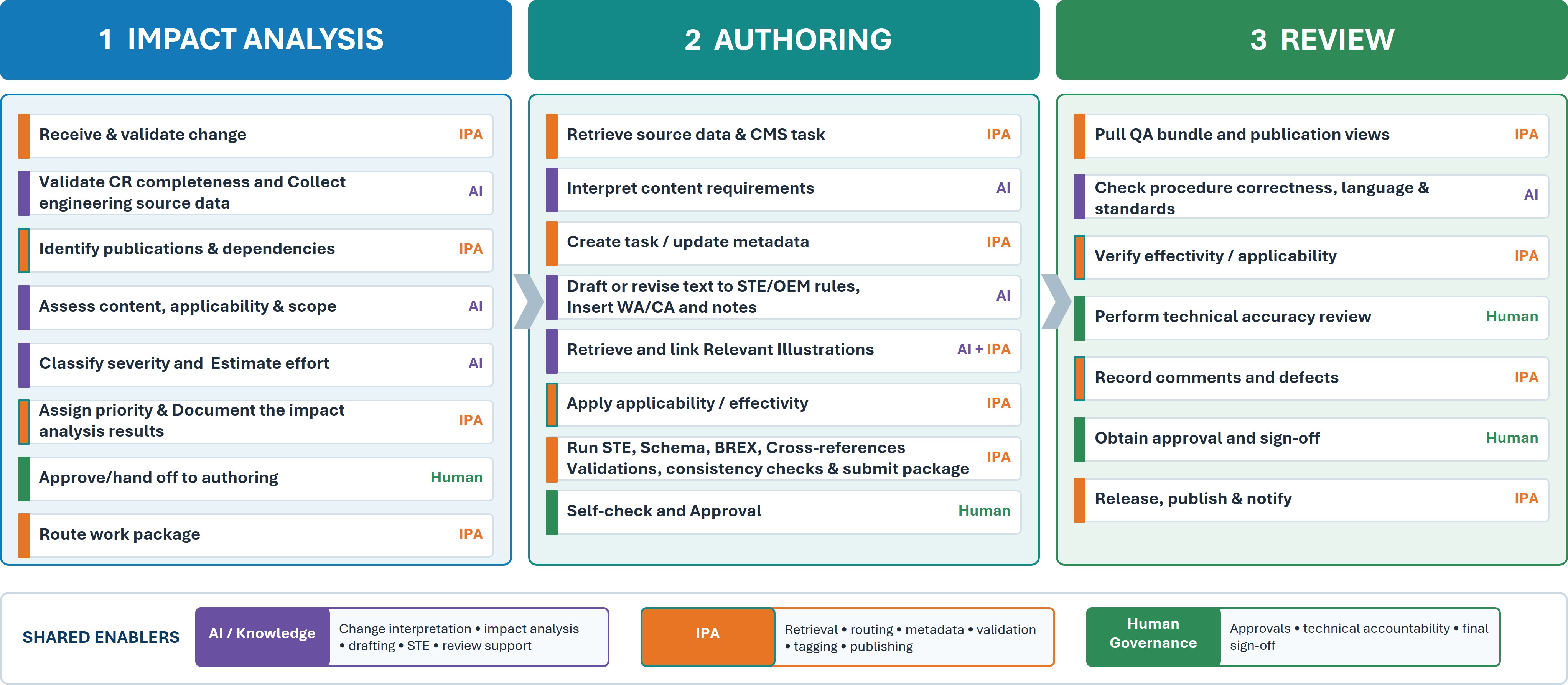
How an agentic technical publication authoring workflow works
- Monitor and receive: The AI agent continuously monitors approved intake channels such as email, customer/OEM portals, workflow tools, Product Lifecycle Management (PLM) and change-management systems and secure file-transfer locations. It captures new change requests, creates work items, queues them based on defined rules, and initiates the authoring workflow.
- Analyse and validate: The agent analyses the change request, checks whether required details are available, identifies impacted manuals, chapters, data modules, or procedures, and flags discrepancies where source inputs are incomplete, ambiguous, or unsupported, routing them to the appropriate SME for resolution. Human reviewers validate the impact analysis and recommendations, modify them where required, and approve the action.
- Author and update: Upon approval, the agent performs controlled authoring activities within the designated Content Management Systems (CMS), Common Source Database (CSDB), or authoring environment. The agent updates affected Standard Generalized Markup Language (SGML)/eXtensible Markup Language (XML) procedures, task content, tooling, consumables, warnings/cautions, illustrations, and applicability information while ensuring technical accuracy, procedural integrity, STE compliance, and adherence to publication standards before committing changes to the authoring environment in accordance with standards and specifications such as S1000D XML and Air Transport Association (ATA) iSpec 2200 for aerospace.
- Validate and notify: The agent performs automated quality checks including content completeness, schema and Business Rules Exchange (BREX) validation, terminology consistency, cross-reference integrity, applicability validation, and compliance with publication rules. It generates a change summary, maintains an audit trail, highlights exceptions for human review, and supports the final approval process. Once approved, the agent can initiate controlled publication and version-release activities, update workflow status, close the request, and automatically notify relevant stakeholders.
The agentic advantage
An agentic authoring solution is more than a standalone chatbot or document generation solution. It functions as an integrated authoring layer connected to enterprise systems such as PLM, CMS, publication repositories, workflow platforms, and authoring tools. With API-enabled connectivity, governance controls, and human-in-the-loop checkpoints, it helps organisations establish a more standardised, controlled, and efficient path for moving change requests from intake through closure.
Key design principles include trust, security, responsible AI, scalability, auditability, and controlled integration with authoring and content systems. This ensures technical publication teams can accelerate updates while retaining expert oversight and compliance discipline.
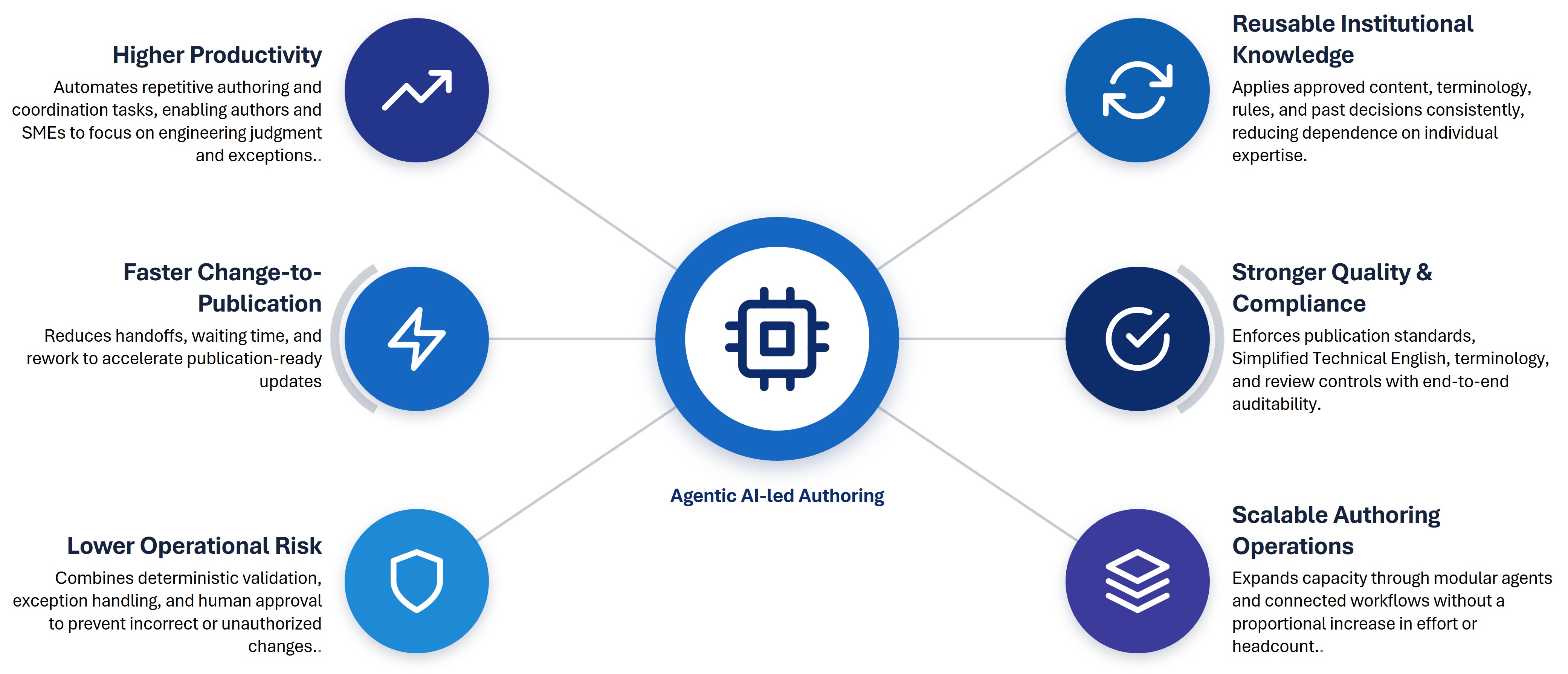
Business benefits of Agentic AI-led authoring
Responsible AI for agentic technical publication authoring
Responsible AI must govern the agentic authoring lifecycle from interpreting engineering changes to approving and publishing updates. The Infosys Scan, Shield, and Steer framework embeds trust through deterministic controls, expert oversight, and regulatory governance.
Scan identifies data, IP, privacy, quality, security, hallucination, and regulatory risks before content advances.
Shield protects content through approved private models, secure access, encryption, masking, source grounding, deterministic rules, automated validation, and human approval. Proprietary data remains within approved boundaries and is not used to train public or unapproved Large Language Model (LLMs).
Steer defines permitted use, accountability, approval thresholds, exception handling, monitoring, and escalation to keep agents aligned with enterprise and regulatory requirements.
Enterprise data and intellectual property remain within approved security boundaries, supported by private or locally hosted models. Such data should never be exposed to, or used to train, public or unapproved LLMs. Regulatory confidence is reinforced through a comprehensive audit trail that connects every request to its authorised sources, AI recommendations, validation outcomes, human decisions, approvals, exceptions, and final publication, providing clear evidence of what changed, by whom, when, why, and against which standard.
The way forward: technical publications that keep pace with engineering change
The future of technical publication authoring will not be defined by automation alone, but by how effectively organisations scale expert judgment across rising change volumes, complex standards, and compressed delivery timelines. Agentic AI provides that bridge through AI-orchestrated authoring workflows, combining intelligent orchestration, standards-aware recommendations, human-in-the-loop governance, and connected transformation levers including Natural Language Processing (NLP), semantic search, GenAI, image intelligence, RPA, and AI-based quality assurance.
For organisations ready to modernise the technical publication value chain, the path forward is clear: start with high-impact authoring use cases, pilot AI-orchestrated workflows with expert oversight, and scale toward a governed Agentic AI authoring ecosystem that delivers speed, consistency, compliance confidence, and operational readiness at scale.
Infosys’s approach to Agentic AI-powered technical publication authoring
Infosys helps organisations reimagine technical publication authoring by combining domain expertise, intelligent automation, GenAI capabilities, agentic orchestration, and human-in-the-loop governance. The approach focuses on building a future-ready authoring ecosystem that can receive and analyse change requests, validate content readiness, recommend compliant updates, execute controlled authoring actions, and support quality review and closure.
Our solution is anchored in practical transformation: identifying high-value use cases across the technical publication value chain, defining streamlined workflows, building agentic and automation layers around existing systems, enabling secure integration with PLM, CMS, and authoring tools, and introducing governance mechanisms that keep experts involved at critical decision points.