


Enterprises today depend on networks that are far more distributed and mission-critical than they were a decade ago. Hybrid clouds, edge environments, SaaS ecosystems, and dispersed workforces have multiplied potential points of failure. In this landscape, the Network Operations Centre (NOC) has become a strategic bulwark for continuity and customer experience, and a key driver of investment in AI in network operations. Nearly 60% of senior leadership across the globe say AI is fully deployed in their network operations.
With momentum building, this shift opens the door to high-value use cases from anomaly detection to automated remediation. The real value emerges in the practical, high-impact applications of AI across everyday NOC workflows.
use cases of AI in NOC: practical wins that businesses care about
Once AI is introduced into network workflows, the immediate business benefits appear in specific, measurable use cases. Key use cases include:
- Dynamic bandwidth allocation: AI systems automatically adjust capacity based on usage patterns, improving performance during spikes and reducing costs during off-peak periods. Telecom providers using AI have significantly improved bandwidth optimisation and reduced energy consumption.
- Automated anomaly detection: Machine learning models analyse large telemetry datasets to detect subtle behavioural deviations long before traditional monitoring tools can, reducing outage risk and protecting customer experience.
- Intelligent incident response and root cause analysis: AI correlates configuration data, traffic logs, and user behaviour to identify systemic issues quickly and improve troubleshooting accuracy.
- Continuous security threat detection: AI/ML models monitor network traffic in real time to identify suspicious behaviour, enabling faster detection of zero-day exploits and emerging vulnerabilities.
These use cases improve visibility and accelerate decision-making, delivering the productivity and continuity gains organisations prioritise. But they are only the beginning. Predictive analytics takes NOC maturity further by shifting operations from reactive response to forward-looking, intelligence-driven foresight.
AI for predictive network analytics: moving from dashboards to foresight
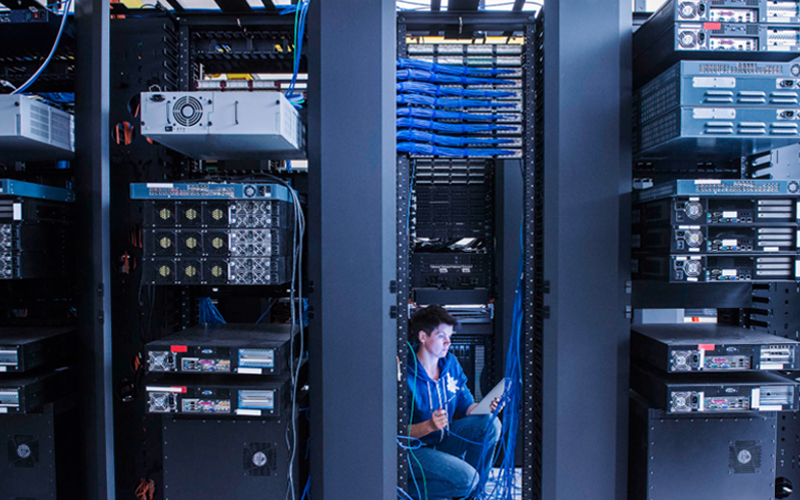
Predictive network analytics embodies how AI changes the NOC’s operating model. By harnessing historical performance and telemetry data, AI models provide actionable forecasts, capacity planning, and risk assessment. Because predictive analytics produces probabilistic forecasts, leaders can prioritise investments (where outages are most likely to occur) and align runbooks and budgets to future demand rather than past incidents. Steps of predictive network analytics include:
- Gathering high-volume usage, traffic, and device-health data
- Cleaning and structuring the data using advanced analytics libraries
- Training machine learning models to predict incidents and recommend resource adjustments
- Leveraging Large Language Models (LLMs) to interpret forecasts and deliver contextual decision support
This proactive stance strengthens SLA adherence and reduces the business impact of capacity spikes, a critical risk for customer-facing services. Organisations using predictive analytics have reduced unplanned downtime by over 40% and process telemetry data far faster than traditional methods, with notable gains in peak load management and service continuity.
These improvements show how predictive forecasting lays the groundwork for a deeper advantage: significantly reducing Mean Time To Repair (MTTR), the metric most directly tied to customer experience and service reliability.
how AI reduces MTTR: the metric that matters
A key metric for NOC efficiency is MTTR, with shorter times directly boosting user satisfaction and service reliability. Downtime directly damages revenue and reputation, but AI-driven automation radically accelerates MTTR reduction through instantaneous anomaly detection and intelligent incident management.
- AI-driven root cause analysis quickly detects, isolates, and prioritises critical issues so teams can focus on what matters most.
- Automated remediation workflows cut manual effort, streamline routine fixes, and allow engineers to concentrate on higher-value tasks.
- AI-enabled incident management accelerates recovery by anticipating failure patterns, guiding corrective actions, and strengthening resilience.
- Improved first-time resolution and faster troubleshooting follow when automation, intelligent alerting, and contextual insights are built into NOC processes, enabling quicker, more confident issue resolution.
A case study shows a 90% reduction in alert noise, sharply lowering daily alerts and enabling a 78% reduction in MTTR by prioritising high-quality, actionable signals. This reinforces that noise reduction is foundational to AI-driven MTTR gains.
Sustaining these gains, however, requires building the right foundations for AI adoption within the NOC.
putting AI into production: governance, data, and talent
To deliver these benefits reliably, organisations must treat AI in network operations as an engineering initiative rather than a point-solution experiment. This requires:
- High-quality telemetry and unified observability to ensure accurate signal capture across hybrid and multi-cloud environments.
- Clear model governance and explainability to support RCA, compliance, and audit-ready operations.
- Tight integration with ITSM, CI/CD, and security workflows to translate AI insights into consistent, actionable responses.
- Operator training and trust-building to validate automated actions and build trust in AI-driven workflows.
Success is iterative: start with supervised anomaly detection and ticket enrichment, measure MTTR improvements and noise reduction, then expand into autonomous remediation as confidence and controls mature.
how can Infosys BPM empower your NOC with AI-first intelligence?
Infosys BPM provides a network and service assurance framework to fortify the future of network operations. Using AI for predictive network analytics, enterprises can transform their NOC into a proactive, predictive, and self-optimising command centre. From AI-driven incident management to analytics-powered capacity planning and automated service assurance, every capability is designed to reduce complexity and elevate performance.
Frequently Asked Question
AI enhances the NOC from a reactive monitoring function to a proactive, intelligence-driven command centre by automating anomaly detection, incident response, forecasting, and optimisation across complex hybrid networks.
High-value use cases include dynamic bandwidth allocation, automated anomaly detection, intelligent incident response and root cause analysis, and continuous security threat detection across large telemetry streams.
Predictive analytics uses historical performance and telemetry data to forecast incidents, guide capacity planning, and highlight high-risk areas so teams can prevent outages and align resources to future demand.
AI reduces MTTR by rapidly identifying root causes, prioritising critical issues, triggering automated remediation workflows, and enriching tickets with context so engineers can resolve problems faster and more accurately.
Successful adoption requires high-quality, unified telemetry, clear model governance and explainability, integration with ITSM and CI/CD workflows, and operator training to build trust in AI-driven automation.