



What happens when a single business decision depends on input from five different AI systems, each built for a different purpose? That question is becoming increasingly relevant as enterprises scale AI across functions. Most organizations now have AI embedded across fraud detection, customer service, finance, risk, and operations, with each function building its own intelligence layer.
In the early stages, this delivers significant value by improving efficiency, accuracy, and experience outcomes. As a result, organizations often measure AI success based on individual use cases and localized outcomes.
This model works only up to a point. As the number of AI systems grows, enterprises face a different challenge: how to coordinate intelligence across systems, not just deploy it within silos. This is where AI Federation becomes important.
AI Federation is an architectural approach where multiple specialized AI systems collaborate through a shared orchestration layer to produce unified business decisions. Rather than operating independently, AI systems exchange reasoning, confidence scores, contextual understanding, and recommendations to create domain-level intelligence.
This blog covers what AI Federation is, how it differs from traditional integration and federated learning, the architectural layers behind it, the governance questions it raises, and when organizations should seriously evaluate it.
Why traditional integration is not enough
Traditional enterprise integration focuses on moving data between systems using APIs, message queues, and integration layers. AI Federation operates differently. It coordinates decision intelligence exchange rather than just data exchange.
For example, in a lending decision, multiple AI systems may contribute:
- Fraud AI detects suspicious behavior
- Risk AI calculates repayment probability
- Pricing AI evaluates profitability
- Compliance AI validates regulatory exposure
- Customer AI assesses relationship value
In many organizations, these outputs are still reviewed manually, slowing decisions and creating inconsistencies. AI Federation enables these AI systems to collaborate automatically and produce a single coordinated recommendation.
AI Federation is not federated learning
AI Federation is often confused with Federated Learning or Federated Data architectures, but they operate at different layers.
Federated learning focuses on training models across distributed datasets without moving sensitive data while data federation focuses on decentralized ownership and access to data across domains.
AI Federation operates at the decision layer. Its purpose is to federate decision-making and reasoning across multiple AI systems that exchange recommendations, confidence scores, explanations, and contextual reasoning to collectively solve a business problem.
The distinction is clear:
- Federated learning exchanges model weights
- Data federation exchanges data
- AI Federation exchanges intelligence
How AI Federation works
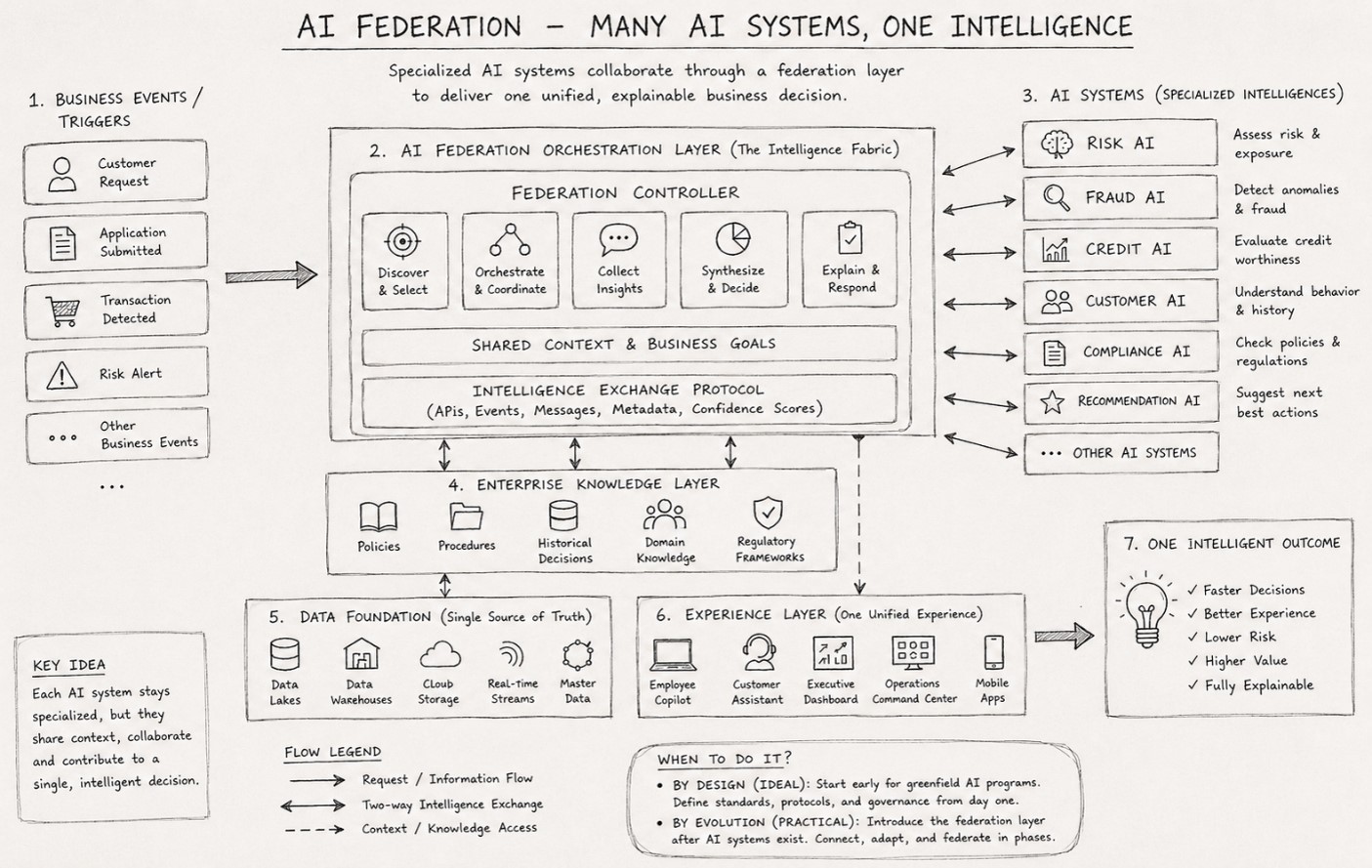
AI Federation can be understood through four key layers.
- Enterprise Event Layer
- AI Service Layer
- Federation Orchestration Layer
Business events trigger decisions, captured through platforms such as Kafka, Azure Event Hub, RabbitMQ, or AWS EventBridge.
AI capabilities are exposed as an API, microservice, agent, or intelligent service. Each AI system publishes standardized outputs including Recommendation, Confidence Score, Explanation, Business Context and Required Actions
This is the core of AI Federation. Technologies such as LangGraph, Semantic Kernel, CrewAI, Azure AI Foundry, or custom Python orchestration frameworks can coordinate AI systems dynamically. This layer determines which AI systems participate, which outputs carry higher priority, how conflicts should be resolved, how final decisions should be synthesized, and how reasoning should be stored for auditability.
From an implementation perspective, organizations can adopt three federation patterns.
- Sequential federation invokes AI systems one after another, where the output of one AI becomes input to the next.
- Parallel federation invokes multiple AI systems simultaneously and consolidates their outputs into a unified recommendation.
- Dynamic federation allows AI agents to determine in real time which other AI systems should participate based on context and business requirements.
Most enterprises will begin with the Parallel Federation and gradually evolve toward the Dynamic Federation as Agentic AI architecture matures.
- Domain Intelligence Layer
This is where the final enterprise recommendation is generated. Instead of receiving multiple disconnected outputs, business users receive a single, explainable domain-level decision.
Governance, ownership and risk
As multiple AI systems contribute to a decision, governance and accountability become critical. Ownership of the final decision cannot remain ambiguous.
Organizations need a clear governance model that defines:
- Ownership of federated decisions
- Escalation mechanisms when AI systems disagree
- Auditability of reasoning and confidence scores
- Regulatory compliance requirements
- Human override thresholds
The federation layer must therefore be seen not only as an orchestration component but also as a control layer that enables trust, explainability, and regulatory alignment.
The most important question in this model is ownership. While multiple systems contribute inputs, the final decision must have a clearly defined owner. Depending on the context, ownership may sit with a business process owner, a human approver, or, in some cases, the federation controller itself. In regulated industries such as banking, insurance, and healthcare, human-in-the-loop decisioning may still be required. AI Federation coordinates inputs, but accountability must remain explicit.
At the same time, AI Federation introduces operational risks. Each additional AI participant increases orchestration complexity, latency, and cost, and organizations must ensure that coordination creates more value than it adds overhead. Conflicting recommendations is another key challenge. For example, a pricing model may support approval while a risk model recommends rejection. Resolving such conflicts requires predefined governance rules, weighting logic, and clear business priorities. As a result, the success of AI Federation depends as much on governance and operating design as on technology.
When should organizations implement AI Federation?
AI Federation is not required for every organization. In many cases, implementing federation too early creates unnecessary complexity. Organizations should evaluate AI Federation when at least three of the following conditions exist:
- More than 5–10 AI systems operate within the same business domain.
- Multiple AI systems produce conflicting recommendations.
- Similar AI capabilities are being developed by different teams.
- Business users manually consolidate outputs from multiple AI systems.
- Regulators or auditors require end-to-end explainability across AI-driven decisions.
- AI operating costs are increasing due to duplicated processing and overlapping models.
When these conditions appear, organizations typically transition from an AI adoption challenge to an AI coordination challenge.
So, when should organizations implement AI Federation?
The timing depends on AI maturity.
Organizations beginning their AI journey should focus on building domain-specific AI capabilities, validating business value, and standardizing AI interfaces. At this stage, introducing enterprise-wide federation may slow down innovation and increase complexity. Instead, organizations should create a federation-ready foundation by standardizing APIs, capturing metadata and confidence scores, and exposing AI capabilities as reusable services. However, as AI ecosystems mature, coordination becomes increasingly important.
Federation becomes relevant when multiple AI systems begin to overlap insights, conflicting recommendations, or create governance challenges. At that point, organizations need coordinated intelligence rather than additional models, and that is where AI Federation becomes a strategic enterprise architecture capability.
The next phase of enterprise AI
AI Federation represents a shift from isolated AI deployments to coordinated decision intelligence at the enterprise level. The future of enterprise AI will increasingly rely more on coordinated systems rather than a single massive, centralized model.
Organizations that coordinate AI effectively can improve decision consistency, reduce duplication, and strengthen governance.
While AI Federation is still an emerging architectural concept, the growing number of AI systems continues to grow, and coordination is likely to become as important as intelligence itself.
How Infosys BPM can help
As organizations move from isolated AI deployments to coordinated decisioning, they need a structured approach across orchestration, governance, and operating models.
At Infosys BPM, we support AI-first business operations by combining domain expertise, reusable AI solutions, and responsible design frameworks. This enables organizations to embed intelligence into core processes, improve decision quality, and scale AI adoption with control and transparency.
Connect with our team and let’s navigate the next in your AI-led transformation journey.
Frequently asked questions
AI Federation is an architectural approach where multiple specialised AI systems collaborate through an orchestration layer to produce unified business decisions. Unlike traditional integration which focuses on data exchange, AI Federation coordinates the exchange of decision intelligence, reasoning, and confidence scores.
AI Federation enables systems, such as fraud, risk, and compliance AI, to exchange recommendations and explanations to collectively solve a business problem. This orchestration ensures that disconnected outputs are synthesised into a single, explainable domain-level decision, reducing the need for manual consolidation.
Enterprises can adopt sequential, parallel, or dynamic federation patterns depending on the complexity of the decision-making process. Sequential federation passes outputs between systems, parallel federation consolidates simultaneous inputs, and dynamic federation allows AI agents to determine which systems should participate in real time.
Federated AI requires clear ownership of final decisions, conflict resolution rules for disagreeing models, and auditable trails of reasoning to ensure regulatory compliance. Organisations must establish human-in-the-loop thresholds and explicit accountability frameworks to manage the operational risks associated with multi-system orchestration.