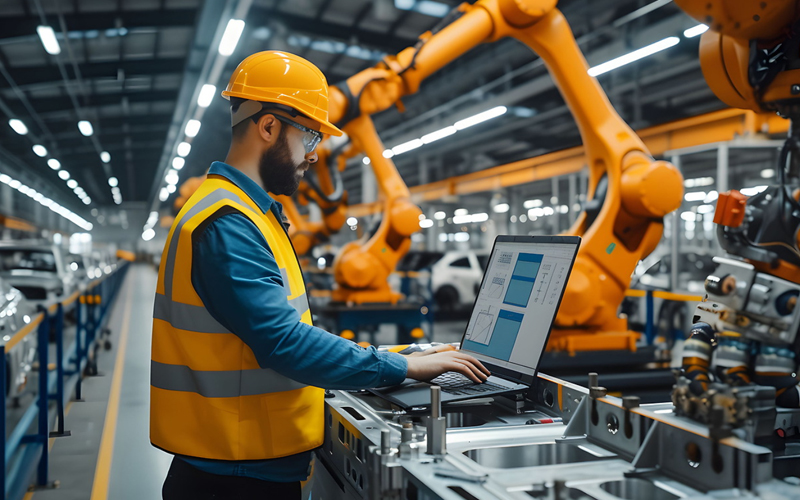
Traditional AI in manufacturing has largely been reactive. It includes systems that analyse data, flag anomalies, and return decisions to humans for action. Agentic AI in manufacturing changes this at the architectural level. Autonomous AI agents perceive real-time conditions across connected systems, reason through those inputs using large language models and neural networks, and execute decisions within defined parameters without waiting for a human to initiate the process. This is a structural change in how smart manufacturing operates.
Understanding agentic AI
Agentic AI systems offer four capabilities that conventional automation lacks:
- Perceive live data from IoT sensors and enterprise platforms
- Reason across that data
- Act autonomously to implement decisions
- Learn continuously from outcomes
This is an essential leap for manufacturing because production environments show high variability, compressed product lifecycles, and supply chains that shift rapidly. Earlier, automation was designed for stable, predictable tasks. Agentic AI is designed for complexity. Industry analysts placed multi-agent systems among the top ten strategic technology trends for 2026, and the global agentic AI market reflects the same momentum. It is valued at approximately $9.89 billion in 2026 and forecast to reach $57.42 billion by 2031 at a CAGR of 42.14%.
Transformative applications across the manufacturing value chain
The manufacturing value chain offers multiple entry points for agentic AI, each producing measurable operational change.
In engineering and design
- Evaluate product performance in simulated real-world conditions
- Generate design alternatives based on material and manufacturing constraints
- Run virtual validation
On the shop floor
- Monitor continuously for quality deviations
- Adjust machine parameters when defects emerge
- Trigger upstream inspections on affected batches without waiting for a shift review
In production scheduling
- Eliminate the need for a cross-functional war room in the event of component shipping delays
- Resequence jobs to prioritise unaffected units
- Rebalance workloads across lines
- Adjust downstream logistics in parallel
What previously required hours of coordination across operations, procurement, and logistics is handled in a single automated decision loop.
Predictive maintenance
AI-enabled predictive maintenance has been discussed in manufacturing for years. Agentic AI adds the ability to act on the insights without waiting for human instruction. When sensors indicate a critical machine is showing early signs of wear, the system schedules maintenance during a planned production window, triggers a parts order, assigns technicians, and redistributes the affected workload to other assets. The notification reaches a human after the response is already underway.
AI-enabled predictive maintenance can decrease maintenance expenses by up to 30% and cut unplanned downtime by 45%. In capital-intensive manufacturing environments where an unexpected line stoppage can cost significant capital per hour, the scale of impact is significant and changes the economics of asset management entirely.
Supply chain resilience through AI agents
Agentic AI addresses inevitable supply chain disruptions by simultaneously monitoring supplier performance, inventory levels, demand signals, and logistics variables, and then adjusting procurement and production strategies before disruptions fully materialise.
A majority of supply chain executives recognise that AI agents embedded into operational workflows accelerate decision-making speed. When autonomous agents handle high-volume repetitive tasks faster than manual processes allow, overall process efficiency improves.AI-driven supply chain solutions can reduce downtime by up to 30% and improve efficiency by 25%. And for manufacturers operating lean inventory models under volatile demand, the combination of speed and resilience drives substantial profitability.
Implementation challenges
Agentic AI is not a plug-and-play capability. It depends on high-quality, real-time data flowing reliably from IoT sensors, manufacturing execution systems, ERP platforms, and supply chain tools into a unified layer. Most manufacturers still carry significant legacy infrastructure and fragmented data environments. Data silos are a structural constraint on deployment speed.
Governance
Autonomous systems making procurement decisions, rescheduling production, or reassigning maintenance resources require clearly defined boundaries, audit trails, and human-in-the-loop controls for high-stakes scenarios. By 2028, 33% of enterprise software applications are expected to include agentic AI, up from less than 1% in 2024.
Reaching that state of deployment assumes that the process frameworks, integration architecture, and governance models to support autonomous systems are already in place.
These favourable outcomes are only attainable when the underlying business processes are clean, connected, and properly governed.
Agentic AI in manufacturing marks a transition from systems that bring insight to systems that reason through problems and act on them, continuously, at scale, and across the full value chain. Predictive maintenance, supply chain resilience, quality control, and dynamic production scheduling are all being redesigned around this capability.
Business process management services provide the process clarity that determines where autonomous decisions are safe and where human judgement remains essential.
How can Infosys BPM help with smart manufacturing?
Infosys BPM manufacturing services are built to standardise and modernise manufacturing process management. We help organisations reimagine manufacturing with AI by combining process transformation, IT integration, and analytics to support intelligent, autonomous manufacturing operations at enterprise scale.
Frequently asked questions
Agentic AI uses autonomous agents that perceive live data from IoT and enterprise systems, reason across that data with LLMs and neural networks, act autonomously within defined parameters, and learn continuously from outcomes. Traditional AI is mostly reactive analysing data and flagging anomalies then waiting for humans to act.
Top use cases include shop-floor quality control (adjusting machine parameters and triggering upstream inspections), dynamic production scheduling (resequencing jobs and rebalancing workloads), predictive maintenance (scheduling service, ordering parts, assigning technicians, and redistributing load), supply chain resilience (monitoring suppliers/inventory/demand/logistics and adjusting strategies), and engineering/design (generating alternatives and running virtual validation).
Organisations report up to 30% lower maintenance expenses and 45% reduction in unplanned downtime via agentic predictive maintenance. In supply chains, AI-driven solutions can reduce downtime by up to 30% and improve efficiency by 25%, accelerating decision speed and boosting profitability under volatile demand.
Agentic AI requires high-quality, real-time data flowing reliably from IoT sensors, MES, ERP, and supply chain tools into a unified layer; manufacturers must address legacy infrastructure and data silos. Governance needs clearly defined decision boundaries, audit trails, and human-in-the-loop controls for high-stakes actions (e.g., procurement, rescheduling, maintenance reassignments).
Start by standardising and cleaning core processes, integrating data sources into a unified layer, and selecting a high-value pilot (e.g., predictive maintenance or quality deviations). Define approval workflows and escalation rules, instrument comprehensive audit logs, and measure KPIs (MTTR, downtime hours, OEE, schedule adherence). Scale iteratively once pilots show measurable gains.