


Manufacturers have spent years connecting machines, collecting production data, and automating repetitive tasks. Those investments created smarter factories, but they did not necessarily enable factories to perceive changing conditions, adapt in real time, or respond autonomously. Physical AI in manufacturing marks the next stage. It combines perception, reasoning, and action, enabling intelligent systems to sense, interpret, and respond to their surroundings with minimal human intervention.
Unlike software-only AI, which produces recommendations or predictions, physical AI acts in the real world through robots, autonomous equipment, and industrial systems. That distinction matters because manufacturers now need agility just as much as efficiency. Industrial AI analytics provides the operational insight that enables these intelligent systems to make more informed decisions.
Software AI thinks. Physical AI acts .
Most organisations already use AI to forecast demand, analyse invoices, or identify maintenance risks. Those systems operate entirely in digital environments. They generate insights, but people or machines still execute the next step.
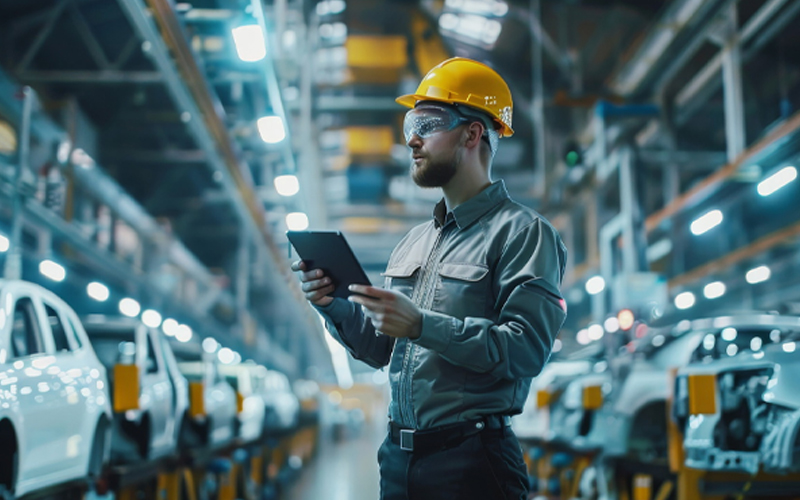
Physical AI in manufacturing closes that gap. A quality inspection robot can detect a defect through computer vision, determine whether the flaw exceeds predefined quality thresholds, remove the faulty component, and continue production with minimal manual intervention. Intelligence extends beyond analysis into autonomous execution.
That difference also introduces new challenges. A chatbot that produces an inaccurate response rarely stops production. A robot that misjudges its surroundings can damage equipment, interrupt output, or create safety risks. Manufacturers therefore place far greater emphasis on rigorous testing, validation, reliability, governance, and safety before scaling physical AI across production environments.
Manufacturing has become the proving ground
Factories offer something many industries cannot: controlled environments with measurable outcomes. Production lines generate structured data, repeatable processes, and clearly defined performance indicators. Those conditions allow organisations to train, test, validate, and refine AI models before deploying them at scale.
Business pressures also continue to mount. Skilled labour remains difficult to secure in many manufacturing sectors. Customers expect shorter lead times and greater product variation. Supply chains still face disruption from geopolitical shifts and economic uncertainty. Physical AI helps manufacturers respond to changing conditions without redesigning entire production systems. Instead of relying solely on fixed instructions, intelligent machines can adapt to changing conditions as they occur.
Why trust matters in physical AI in manufacturing

The conversation has shifted. Manufacturers no longer ask whether they should automate another process. They ask whether they can trust an AI system to make safe, consistent decisions when conditions change unexpectedly.
That explains why digital twins, simulation environments, and continuous monitoring receive so much attention. Organisations increasingly test AI models in virtual production environments before introducing them to the factory floor. They validate behaviour, identify unexpected outcomes, and refine performance before physical deployment. Trust is built through evidence rather than assumption.
Some industry experts also caution against expecting immediate autonomy. Foundation models continue to improve, but manufacturers still depend on human judgement for complex decisions, regulatory compliance, and exception handling. Physical AI augments human capability rather than replacing it outright.
Physical AI moves beyond the smart factory
A connected factory collects information. A factory integrating physical AI in manufacturing responds to it.
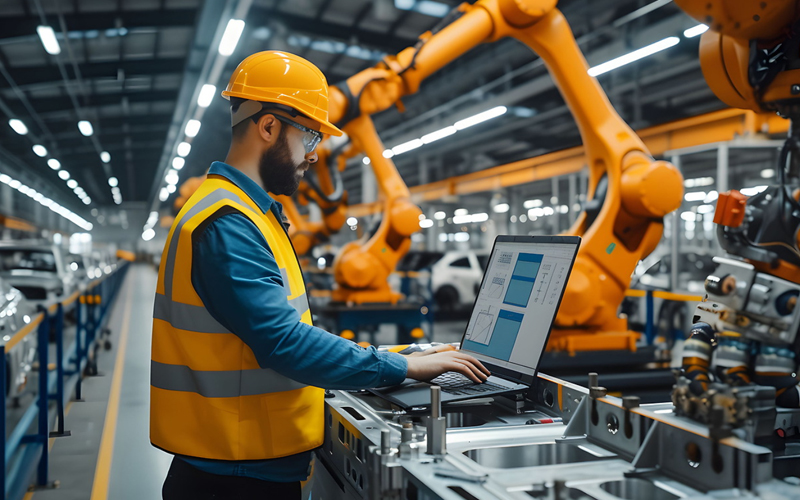
Imagine an assembly line that produces several product variants every day. Traditional automation often requires engineers to stop the line and reprogramme robotic movements between production runs. Physical AI allows robots to recognise different components, adjust their movements, and continue operating with minimal interruption. That flexibility reduces downtime while improving responsiveness to changing customer demand.
Another example comes from quality inspection. World Economic Forum examples show that intelligent robotic deployments have improved production cycle times by 20–30%, reduced error rates by 25%, and shortened deployment times by 40% in selected manufacturing environments. While results vary by implementation, these improvements illustrate how intelligent systems can support measurable operational performance rather than simply introducing another layer of automation.
Where manufacturers should begin
Physical AI in manufacturing does not require organisations to replace every machine on the factory floor. Most successful programmes start much smaller.
- Manufacturers should identify one operational constraint with measurable business impact. That could involve quality inspection, material handling, predictive maintenance, or production scheduling.
- They should validate the solution through pilots, simulations, and measurable operational KPIs before expanding deployment.
- They should strengthen data quality, governance, and workforce capability alongside technology investments.
This measured approach allows industrial AI analytics to generate better operational insight while supporting operational excellence through BPM across manufacturing functions. More importantly, it reduces implementation risk and helps leadership teams evaluate outcomes using business metrics rather than technical milestones.
How can Infosys BPM help with physical AI in manufacturing?
Infosys BPM helps manufacturers translate AI investments into measurable operational outcomes by combining intelligent automation, data-driven decision-making, and scalable operational frameworks. Through advanced industrial AI analytics, AI-enabled process optimisation, and flexible transformation strategies, Infosys BPM enables manufacturing organisations to improve agility, strengthen resilience, and accelerate the adoption of physical AI while integrating it with existing operations and business processes.
Explore how the manufacturing BPM services from Infosys BPM can help your organisation harness physical AI in manufacturing to improve operational performance and support long-term business growth.
Frequently asked questions
Physical AI in manufacturing refers to intelligent systems that can perceive their environment, reason about conditions, and take action in the physical world. Unlike software-only AI, it works through robots, autonomous equipment, and industrial systems to support real-time decision-making and execution.
Traditional automation follows pre-set rules and fixed instructions, while physical AI can adapt to changing conditions in real time. This makes it more useful for dynamic manufacturing environments where product variation, quality issues, or supply disruptions require flexible responses.
Common use cases include quality inspection, predictive maintenance, material handling, production scheduling, and robotic assembly. These applications help improve efficiency, reduce errors, and make operations more responsive.
The main challenges are safety, reliability, governance, and trust. Since physical AI interacts directly with machines and production lines, manufacturers need strong testing, validation, simulation, and monitoring before large-scale deployment.
Manufacturers should begin with a focused pilot in one area with measurable impact, such as defect detection or maintenance. They should test the solution in simulations, track KPIs, strengthen data quality, and scale gradually based on proven results.