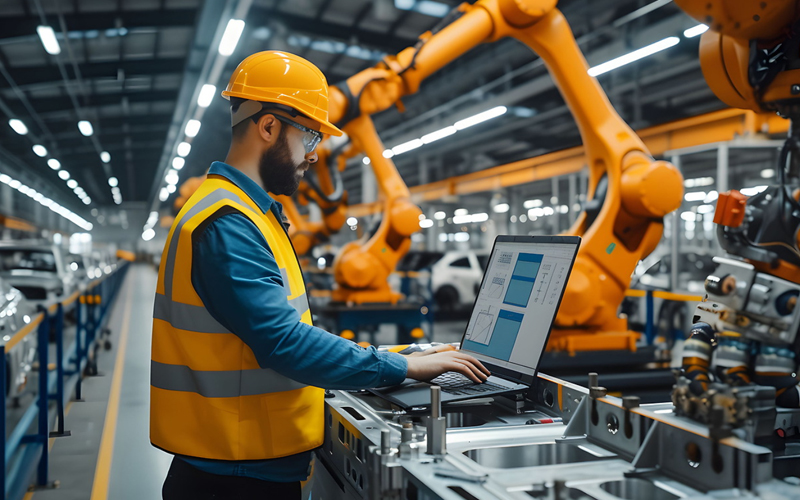



Introduction: Why governance is the gate to scaling AI in manufacturing
As AI takes on a more active role in manufacturing, it is no longer limited to analysing production data or generating insights. Contemporary AI systems can recommend process changes, optimise production schedules, initiate maintenance workflows, and, in some cases, execute decisions with minimal human intervention. As organisations scale these capabilities, governance often determines whether AI scales successfully.
AI governance in manufacturing is the operational framework that governs how AI systems make, monitor, and execute decisions safely across production environments. Although the core principles of responsible AI remain relevant, manufacturing introduces operational realities that demand a more specialised governance approach. Understanding these challenges, the risks they create, and the best practices for governing AI at scale is essential for building resilient, future-ready operations.
Why AI governance is different in manufacturing
Unlike AI deployed in business functions, AI governance in manufacturing must address decisions that directly influence physical operations, industrial systems, and worker safety, making the consequences of failure far more immediate. A model that misclassifies a customer enquiry may create delays. A model that incorrectly adjusts a machine parameter can disrupt production, damage equipment, or create safety risks. That difference requires governance designed specifically for manufacturing environments.
Key considerations for AI governance in manufacturing environments include:
- Physical and safety-critical outcomes: AI decisions can affect machinery, product quality, and employee safety, requiring stricter oversight than data-centric applications.
- OT/IT convergence: As AI connects enterprise applications with operational technology, organisations must secure every interface between enterprise systems and the shop floor to minimise cyber and operational risks.
- Real-time autonomous decisions: Agentic AI systems can respond in seconds, leaving little opportunity for manual intervention. Governance should define autonomy limits before deployment rather than relying on reactive controls.
- Third-party AI dependencies: Manufacturers increasingly rely on external AI models, software, and connected devices, making vendor governance, supply chain transparency, and accountability essential components of responsible AI in manufacturing.
These manufacturing-specific realities explain why generic AI governance frameworks alone cannot adequately support safe, scalable industrial AI adoption.
Key AI governance risks in manufacturing
The greatest challenges in AI governance in manufacturing emerge when AI moves beyond analysis to influence production decisions, where safety, reliability, compliance, and accountability become tightly interconnected.
As autonomous capabilities expand, manufacturers need controls that reduce operational risk without limiting innovation. Identifying the most common risk areas is the first step towards implementing responsible AI in manufacturing.
| Risk | Recommended governance control |
| Unsafe or unauthorised AI actions | Define risk-based autonomy levels and require human approval for high-impact decisions affecting safety, quality, or production continuity. |
| Model drift in live production | Continuously monitor model performance, detect drift early, and establish clear retraining and validation triggers. |
| Increased OT/IT security exposure | Protect AI-to-OT interfaces through network segmentation, role-based access controls, and regular security assessments. |
| Limited transparency in AI decisions | Maintain explainable outputs and comprehensive audit trails for every significant recommendation or automated action affecting production. |
| Regulatory and standards non-compliance | Align governance processes with the EU AI Act, NIST AI RMF, ISO/IEC 42001, and applicable machinery and functional safety requirements. |
| Unclear ownership and oversight | Assign accountable business owners and establish a cross-functional AI governance committee with defined escalation procedures. |
Ultimately, effective AI governance in manufacturing depends on anticipating these risks and embedding the right controls before AI reaches the production floor.
Best practices for responsible AI in manufacturing
Successful implementation of responsible AI in manufacturing relies on practical governance measures that balance innovation with operational safety, accountability, and compliance. Rather than applying the same controls to every AI use case, manufacturers should tailor governance to the level of operational risk and autonomy involved.
A practical governance checklist to operationalise a responsible AI framework includes:
- Assess use cases by risk level and define clear autonomy boundaries before deploying AI into production environments.
- Match human oversight to the level of risk. Reserve human approval for high-impact decisions, while allowing routine, low-risk actions to operate under appropriate supervision.
- Ensure every critical AI decision is traceable through audit logs and explainable outputs that support investigations and regulatory reviews.
- Monitor AI continuously by tracking model performance, drift, and operational safety indicators throughout the production lifecycle.
- Secure the OT/IT boundary with robust cybersecurity controls wherever AI interacts with industrial systems and connected equipment, such as MES, SCADA platforms, or industrial robotics.
- Establish clear governance ownership through a cross-functional team representing operations, quality, safety, engineering, IT, and risk management.
- Apply consistent governance standards to third-party AI by evaluating vendors, models, and connected technologies against the same security, compliance, and performance requirements as internally developed solutions.
Together, these AI governance best practices enable manufacturers to scale AI responsibly while maintaining trust, resilience, and operational continuity.
Standards and regulations: What applies to manufacturing AI
Effective AI governance in manufacturing aligns AI-specific governance requirements with established industrial safety and compliance obligations. Manufacturers should build governance programmes around recognised frameworks while ensuring they complement existing operational controls.
Key AI governance standards manufacturers should implement include:
- The EU AI Act, which applies a risk-based approach and can classify AI in safety components as high risk, requiring additional governance measures.
- The NIST AI Risk Management Framework (AI RMF), which helps organisations identify, assess, and manage AI-related risks throughout the lifecycle.
- ISO/IEC 42001, which provides requirements for establishing and improving AI management systems.
These frameworks should complement existing functional safety, machinery, and operational risk management requirements rather than replace them. Together, they help organisations establish consistent, compliant, and scalable AI governance and compliance practices as AI adoption continues to expand.
How Infosys BPM embeds governance into manufacturing AI operations
Embedding governance into day-to-day operations helps manufacturers scale AI with confidence while maintaining safety, compliance, and operational resilience.
Infosys BPM's approach
Infosys BPM integrates AI governance in manufacturing into every stage of AI adoption, ensuring governance evolves alongside deployment rather than becoming an afterthought. This approach enables organisations to innovate faster without compromising oversight or regulatory readiness of their manufacturing operations.
Key capabilities Infosys BPM offers include:
- Designing governance models based on risk tiers, autonomy levels, and appropriate human oversight for each manufacturing use case.
- Monitoring production models through deployment to detect performance issues, model drift, and safety risks before they affect operations.
- Aligning governance processes with the EU AI Act, NIST AI RMF, ISO/IEC 42001, and relevant industrial safety requirements.
- Embedding governance directly into managed manufacturing operations so governance controls become part of everyday production processes.
Connect with Infosys BPM to assess your manufacturing AI initiatives and build a governance strategy that supports responsible AI adoption at production scale.
Conclusion
As AI becomes more autonomous, AI governance in manufacturing is essential for scaling innovation without compromising safety, compliance, or operational resilience. Addressing the physical, OT, and real-time realities of manufacturing requires purpose-built governance controls from the outset.
Talk to Infosys BPM about building an AI governance strategy that supports your agentic AI for manufacturing journey.
FAQs: AI governance in manufacturing
AI governance in manufacturing is the framework of policies, processes, and oversight that ensures AI systems operate safely, reliably, and in compliance with regulations. It defines how organisations monitor, control, and hold AI systems accountable across manufacturing operations.
Manufacturing AI can directly influence machinery, production processes, and worker safety. Unlike AI used for business tasks, errors can have immediate physical and operational consequences, making robust governance essential before deploying AI at scale.
Key AI governance best practices include assessing AI use cases by risk, defining autonomy limits, maintaining human oversight for critical decisions, monitoring model performance, securing OT/IT environments, and assigning clear governance ownership.
Manufacturers should align AI governance compliance with the EU AI Act, NIST AI Risk Management Framework (AI RMF), ISO/IEC 42001, and applicable functional safety and machinery regulations to support safe, compliant, and responsible AI adoption.