


For years, retail pricing followed a predictable rhythm—set once, reviewed occasionally, and adjusted mainly through promotions or end-of-season markdowns. That model held up when consumer expectations were steady, and competitive dynamics moved slowly.
Not anymore.
Today’s retail landscape is shaped by always-on shoppers, fluid demand cycles, and competitors that can shift prices in minutes. Pricing has now become one of the most influential drivers of retail performance. Research shows it impacts 30 to 40 percent of revenue, and 75 percent of shoppers expect prices that reflect their preferences and real-time context.
This reality has accelerated the move from static price tags to intelligent pricing systems that respond to market signals, buying behavior, and competitive movement as they happen. Dynamic pricing is no longer a tactical option. It is a core capability for retailers aiming to improve profitability, sharpen competitiveness, and increase precision in decision-making.What was once a tactical tool is now a dynamic, data-fueled strategic driver. Static price tags are being replaced by intelligent systems that respond to demand shifts, behavioral patterns, and competitive activity in real-time. Dynamic pricing, which adjusts prices in real-time based on factors such as market demand, competition, and consumer behavior, has become an essential tool for retailers to maximize revenue, maintain competitiveness, and offer personalized pricing to customers.
This blog explores how dynamic pricing, powered by real-time data and AI, is not just as a margin play but is transforming retail profitability, competitiveness, and customer experience.
market realities reshaping pricing strategies
Retailers are constantly navigating rising consumer expectations, shrinking margins, and omnichannel complexity. eCommerce has redefined how consumers discover, evaluate, and purchase products, placing pressure on retailers to be as agile in pricing as they are in delivery.
Key trends reshaping the pricing function:
- digital disruption: Brick-and-mortar coexist with online and mobile channels, necessitating unified pricing across touchpoints.
- competitive dynamics: Price benchmarking and instant comparisons are the norm, intensifying the need for price agility.
Retailers across sectors are already leveraging dynamic pricing to achieve strategic outcomes:
- fashion & apparel: Brands apply real-time markdowns during product launches and end-of-season clearances, balancing sell-through rates with brand positioning.
- grocery & convenience: Electronic shelf labels (ESLs) adjust prices throughout the day based on footfall, perishability, or weather conditions, minimizing waste and maximizing revenue.
- perishables: Prices are dynamically reduced on items nearing expiry to drive timely liquidation while minimizing loss.
- e-commerce & marketplaces: Sophisticated algorithms analyze browsing patterns, past purchases, and stock availability to personalize offers and promotions at scale.
why legacy pricing strategies fall short
Traditional pricing models face several significant challenges that hinder their effectiveness in today’s fast-evolving retail landscape.
- poor scalability: Uniform pricing models can't handle expansive product catalogs or dynamic market conditions.
- data fragmentation: Misalignment between customer behavior, marketing, inventory levels, and competitor prices can lead to inconsistent pricing strategies.
- elasticity blindness: Inability to understand and adapt to the nuanced relationship between price changes and consumer demand; traditional models often lead to potential revenue losses.
- lack of flexibility: Insufficient ability to respond to shifts in consumer preferences or unexpected disruptions, resulting in missed opportunities for real-time pricing adjustments.
- inefficient inventory liquidation: Static pricing often results in excess stock remaining unsold or products being discounted too late, directly impacting margins.
- disconnected channel strategies: Legacy systems often price products differently across channels (in-store vs. online), eroding customer trust and weakening omnichannel cohesion.
- slow decision cycles: Manual processes and outdated tools delay pricing updates, making retailers vulnerable to rapid competitor moves or demand shifts.
As retailers face these challenges, the ability to dynamically adjust prices based on real-time data has become critical. However, many struggle with the complexity of implementing dynamic pricing models that not only account for market changes but also ensure customer satisfaction and loyalty. This shift demands sophisticated technologies, strategies, and a deeper understanding of consumer psychology to maintain a competitive edge in an increasingly data-driven marketplace.
strategic framework: intelligent price optimization
The shift from static to dynamic pricing is complex and requires a structured, data-led approach. A robust pricing framework begins with a clear understanding of product performance, evaluated through two critical metrics: user interest (CTR) and actual revenue contribution. When mapped together, these indicators form distinct product cohorts that reveal how customers engage with an item and how effectively it converts.
Each cohort warrants a different strategic response, whether it is recalibrating the price, refining the value proposition, or sustaining current efforts. This segmentation provides retailers with a more precise lens to diagnose performance issues and design interventions that strengthen both profitability and customer relevance.
revenue vs click-through-rate: performance evaluation framework
Retailers can begin with a CTR-Revenue Performance Matrix, which segments product performance into actionable cohorts:
CTR vs Revenue |
Strategy |
Why It Matters |
🔺 High Demand/CTR, |
Reduce price strategically |
Strong interest but low revenue suggests overpricing. Strategically lower prices to convert potential buyers. |
🔻 Low Demand/CTR, |
Reevaluate and discount price |
Low demand and revenue indicates The product isn’t resonating. Consider discounts and recover revenue. |
🔺 High Revenue |
Maintain or optimize by slightly increasing price |
The product is performing well; there's strong interest and profitability. Focus on prioritizing margin optimization while maintaining stable demand. |
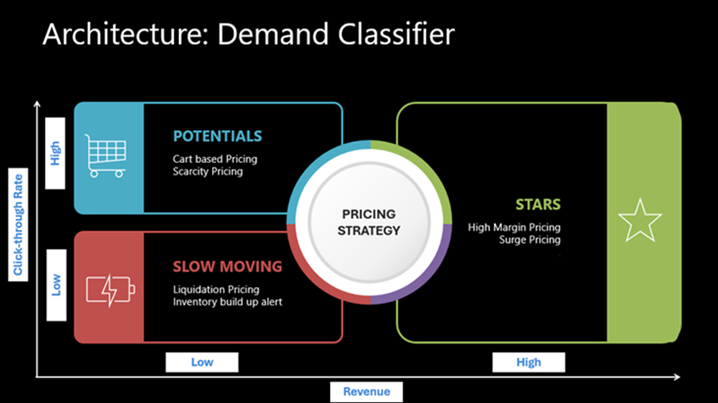
This simple yet powerful framework enables retailers to dynamically optimize pricing by aligning business goals with consumer behavior.
These strategies are further enhanced when powered by an AI-driven dynamic pricing solution, which continuously analyzes real-time data such as demand signals, user behavior, and competitive pricing to automate optimal price decisions at scale. This ensures that pricing remains responsive, data-backed, and aligned with both customer expectations and business objectives.
measuring the true ROI of dynamic pricing
Dynamic pricing is not just a revenue lever, it’s a multi-dimensional strategic growth tool. To evaluate its true ROI, retailers must look beyond short-term margin gains and consider its impact across three dimensions: financial performance, strategic positioning, and customer value.
Successful implementations have delivered substantial outcomes, such as:
- 5–20% revenue uplift
- 2–10% margin expansion
- 20% increase in customer lifetime value
Beyond numbers, a transparent and ethical dynamic pricing strategy builds consumer trust, reinforces brand credibility, and positions retailers as customer-centric and responsive—essential attributes in an experience-driven economy.
partnering for dynamic pricing success
At Infosys BPM, we help retailers develop and execute dynamic pricing strategies that balance innovation with integrity. The Infosys Dynamic Pricing Solution ensures pricing is not just reactive, but a strategic, ethical, and scalable capability that aligns with broader enterprise objectives.
Our capabilities include:
- data processing workbench: We centralize sales, website, and competitor data for actionable pricing insights.
- price recommendation engine: Our AI-driven engine recommends optimal pricing strategies based on demand and historical data.
- pricing implementation layer: We support bulk pricing updates, manual overrides, and ensure consistent pricing across all channels.
Connect with our team today and explore how our Dynamic Pricing Solution can help you strengthen your bottom line with intelligent pricing strategies that protect your margins and elevate every customer touchpoint.
FAQ
Data-driven dynamic pricing uses real-time data analysis to adjust prices based on demand, competitor pricing, and market conditions. By utilizing algorithms and AI to optimize pricing strategies, retailers can maximize revenue, reduce inventory waste, and respond to market fluctuations. This approach helps retailers stay competitive while improving profit margins through smarter pricing decisions.
Key benefits include improved revenue optimization, enhanced customer satisfaction through personalized pricing, and the ability to stay agile in competitive markets. Dynamic pricing allows retailers to adapt quickly to changes in demand, inventory levels, and competitor actions, ensuring prices remain optimal at all times. This leads to better sales performance, increased customer loyalty, and operational efficiency.
Retailers face challenges such as data integration issues, the complexity of pricing algorithms, and customer perception of frequent price changes. Overcoming these challenges requires robust data infrastructure, clear communication with customers, and continuous monitoring of pricing models. Addressing these challenges ensures a smoother implementation and a positive customer experience while maximizing profitability.
AI enhances dynamic pricing by processing large datasets in real-time, identifying patterns, and forecasting demand. Machine learning models help retailers optimize pricing decisions by predicting how price changes will affect consumer behavior, demand, and revenue. This leads to more accurate, data-backed pricing strategies that boost profitability and improve market competitiveness.