


airline cargo service with smart BPM solutions
Enhance Load Planning & Space Utilization
Airline cargo services
Infosys BPM airline cargo services help airlines and cargo operators run the full cargo lifecycle, from booking and space optimisation to airway bill verification, rate management, claims, and revenue accounting, with greater accuracy and lower cost. The airline cargo industry is a vital part of the global supply chain, transporting goods by plane to connect manufacturers, suppliers, and consumers. Airline cargo is a critical component of modern logistics, and is especially important for time-sensitive, bulk, or high-value shipments.
According to IATA (International Air Transport Association), airline cargo moves over $8 trillion worth of goods, accounting for approximately 33% of world trade by value. A GII research report valued the global air cargo market at $185.3 billion in 2023 and projects it to grow at a CAGR of 4.3% between 2024 and 2032. The rise of e-commerce has increased the volume of goods shipped globally, leading to a greater demand for airline cargo.
Some of the key challenges plaguing the airline cargo industry are:
 Revenue leakage
 AWB disputes & rejections
 High cost of operations
 Low eAWB penetration
 Service quality issues
We offer a comprehensive suite of air cargo business process outsourcing services designed to optimize operations and drive exceptional outcomes.

Why choose us for airline cargo services?
Our air cargo management services include booking support, general customer support, space optimization, cargo IQ reporting, AWB verification, quote and rate management, contract management, claims management, operational analytics, and revenue accounting. Leveraging Infosys proprietary or partner-developed intelligent tools, we commit to creating lean, highly efficient and customer centric airline cargo BPM unit for you.
Our comprehensive suite of services
Leveraging our expertise across a diverse range of industries and the latest technology, our air cargo solutions deliver measurable value in terms of improved operational efficiency, cost reduction, and enhanced customer experiences. We help you streamline and enhance back-office processes, ensuring global connections are handled with precision and care. As a pioneer in IT and BPM services, and a strategic partner of IATA, Infosys had the opportunity to deliver excellence for some of the eminent players of the aviation industry and help them navigate their digital transformation journey. At Infosys, we leverage automation, artificial intelligence (AI) and predictive analytics to deliver an omnichannel customer experience. Infosys Nia, our AI-powered chatbot, understands the context and intent of customer interactions and responds to queries regarding specific shipments as well as frequently asked questions on booking, pickup scheduling, packaging, payment, taxes, transit time, delivery, etc.
Infosys : Airline cargo BPM services
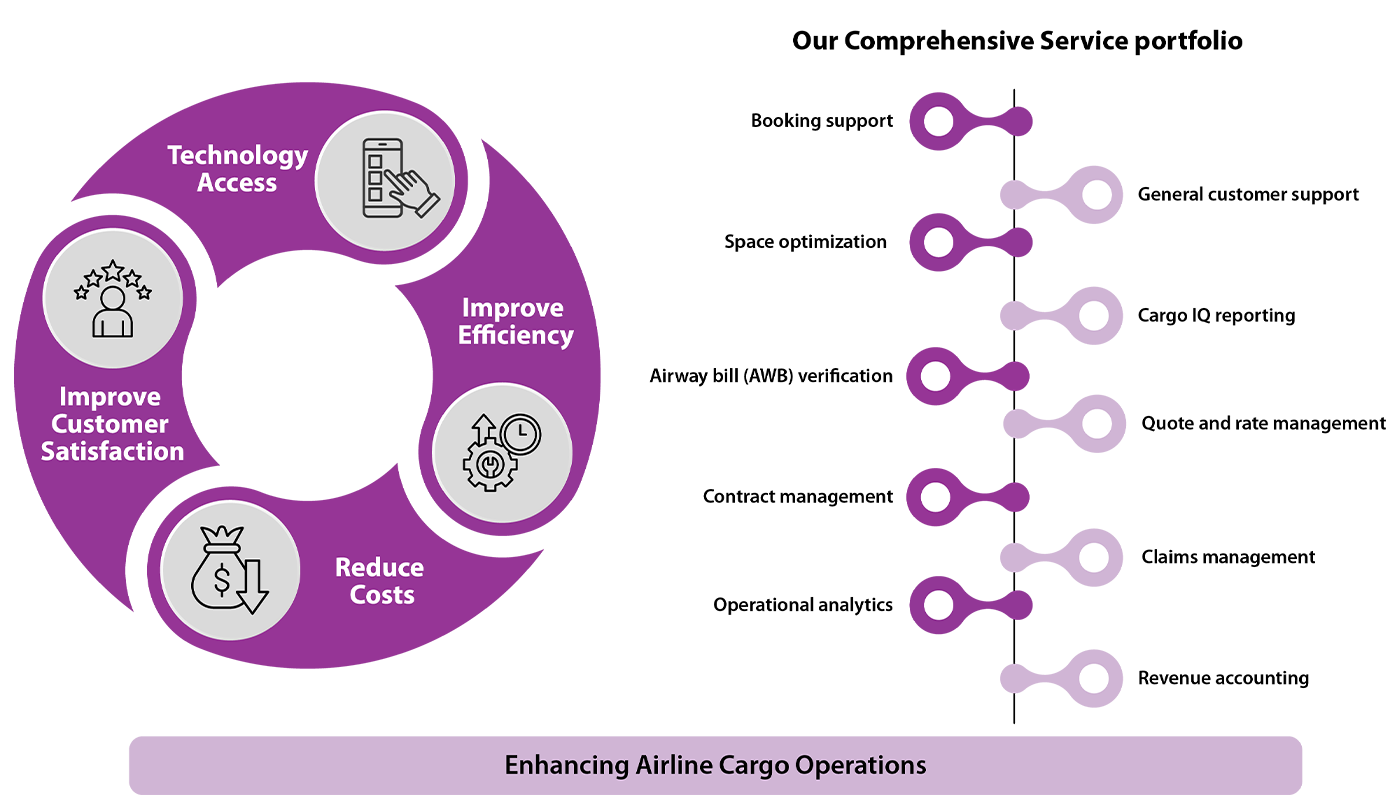
Our BPM services for airline cargo not only address immediate operational challenges but also position airlines for long-term success by fostering innovation, building resilience, and creating a competitive edge in the global airline cargo market.
Booking support
- Space availability
- Compatibility of the shipment to the ULD and aircraft type
- Completeness of the information
Space optimization/load planning
Optimal space utilization & planning for trucks & freighters:
- Load planning : Based on the existing bookings on the flight
- Capacity planning : Actual capacity of the flight
- Creating instructions for loading aircraft (including balancing)
ULD inventory control
- Manage ULD network across the network queue management (e.g. ULD does not exist in the system)
Cargo IQ
- Monitoring & reporting on the performance against set milestones
Cargo claims management
- Check for completeness of the claim form
- Check for all supporting documents such as AWB, proof of damage, surveyor's report, invoices, etc.
- Acknowledge the claim & initiate investigations
- Request for further evidence/documentation
- Process the claim & mark closure
Operational analytics
Analysis report for various scenarios, such as:
- Flight capacity full
- Booking exceeds capacity
- Previous offload backlog
- Not collected by airside
- Not built on time
- Space available but not planned
Cargo revenue accounting
- AWB verification
- Flown accounting
- Interline accounting
- MDM
- Rate audit
Resource center


Challenges and solutions – airline cargo
The right partner combines aviation cargo domain depth with measurable operational outcomes and a clear technology model. Look for proven experience across the cargo lifecycle, from booking and space optimisation to airway bill verification, rate management, claims, and revenue accounting, so operations are not split across vendors. Assess how they tackle the industry's structural problems, revenue leakage, AWB disputes, and low electronic AWB adoption, and ask for evidence of recovery and accuracy improvements. Evaluate the maturity of their automation and AI, the strength of cargo systems integration such as Cargo IQ milestone reporting, and the flexibility to scale with seasonal and route demand. The strongest partners reduce cost while protecting yield and service quality.
The highest-value processes are the high-volume, rules-based, and seasonal ones that strain internal teams. Booking support and space or load planning improve aircraft utilisation. Airway bill verification and quote and rate management reduce disputes and protect pricing. ULD inventory control keeps equipment visible and available. Cargo claims management and revenue accounting recover value that manual processes leak, and operational analytics turn shipment data into performance decisions. Cargo IQ milestone monitoring strengthens service reliability. Frontline commercial relationships and network strategy usually stay in house, while the operational volume behind them moves to a managed model. The aim is to match each process to the model that delivers accuracy, speed, and cost control.
Revenue leakage usually comes from inconsistent rating, unbilled charges, AWB disputes, and weak reconciliation between booking, operations, and accounting. Managed cargo services close these gaps by standardising rate and quote management, verifying airway bills against agreed terms, and running revenue accounting through controlled, auditable workflows. Automation flags discrepancies early, before they become write-offs, and analytics surface patterns in disputes and rejections so root causes are fixed, not just corrected case by case. Consistent processes across stations also reduce the variation that lets charges slip. For a cargo finance leader, the result is tighter billing accuracy and recovered yield, achieved through process discipline rather than added headcount.
AI is automating the repetitive, document-heavy layers of cargo operations and adding intelligence to commercial decisions. Airway bill processing, rate validation, claims triage, and milestone tracking can be automated, while analytics turn booking, capacity, and shipment data into pricing and load decisions. Predictive views help anticipate demand and protect capacity during peaks. Infosys BPM applies the Topaz AI framework within managed airline cargo services, so these capabilities reach the cargo team as faster operations, fewer disputes, and better yield rather than as systems the airline must build and maintain. Commercial and network judgement stays with the airline; AI removes the operational load around it.
Low eAWB penetration usually persists because of inconsistent processes across stations, partners on different systems, and manual fallback when exceptions arise. A managed approach raises adoption by standardising the airway bill workflow, integrating with partner and industry systems, and handling exceptions through a consistent process rather than reverting to paper. Trained teams apply the same data standards across the network, and analytics highlight where adoption stalls so effort targets the real bottlenecks. Higher eAWB penetration reduces handling cost, speeds processing, and improves data quality for downstream billing and analytics. For an airline, it is less a technology purchase than an operating-discipline outcome that a managed model can sustain.
Request for services
Find out more about how we can help your organization navigate its next. Let us know your areas of interest so that we can serve you better.