





advanced quality management systems for manufacturers
discover how Infosys BPM is revolutionizing quality management systems
Know MoreQuality management systems & services (QMS)
Managed quality management services for manufacturers
At Infosys BPM, we deliver managed quality management systems (QMS) and services that help manufacturers assure product and supplier quality with cutting-edge digital and analytic tools. Our managed support services boost efficiency, ensure compliance, and foster continuous improvement, prioritising operational excellence and innovation. Our solutions are tailored to exceed the stringent requirements of quality assurance and quality control (QA/QC) functions.

Why quality management systems (QMS) digitization can’t wait?
As manufacturing evolves keeping pace with global quality mega trends, digitizing QMS activities has become the cornerstone of competitiveness. By streamlining processes and delivering real-time insights, digitization empowers manufacturers to enhance efficiency, accuracy, and compliance in a rapidly transforming industry.
Global quality mega trends


Our service offerings covering the quality value chain
Quality planning (QAP, APQP etc.)
Inspection management (FAI, PPAP etc.)

Quality control support
Quality cost management (COPQ, Cost recovery etc.)
Post-shipment quality control

Compliance & certification

Continuous improvement support

CAPA & SCAR management

Quality reporting & analytics

Supplier quality support
AI-powered quality management
This AI-powered quality management system (QMS) enables you to proactively assure product and supplier quality by combining visual inspection, intelligent audits, and automated document validation. By embedding AI agents across inspection, compliance, and review workflows, we help reduce defect leakage, accelerate quality decisions, and achieve continuous compliance with greater transparency and scalability.
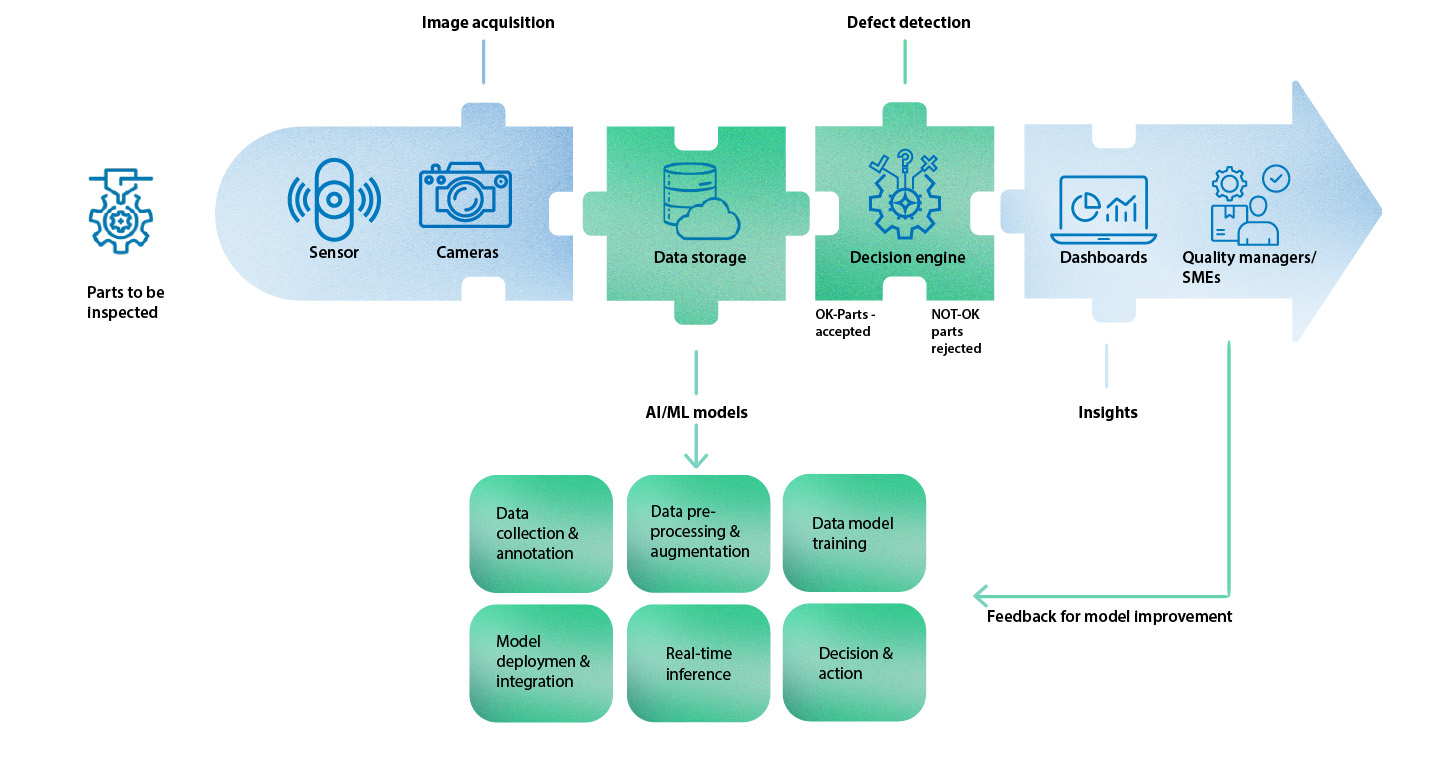
 AI/ML-led visual quality inspection
 AI agent-led supplier quality audits
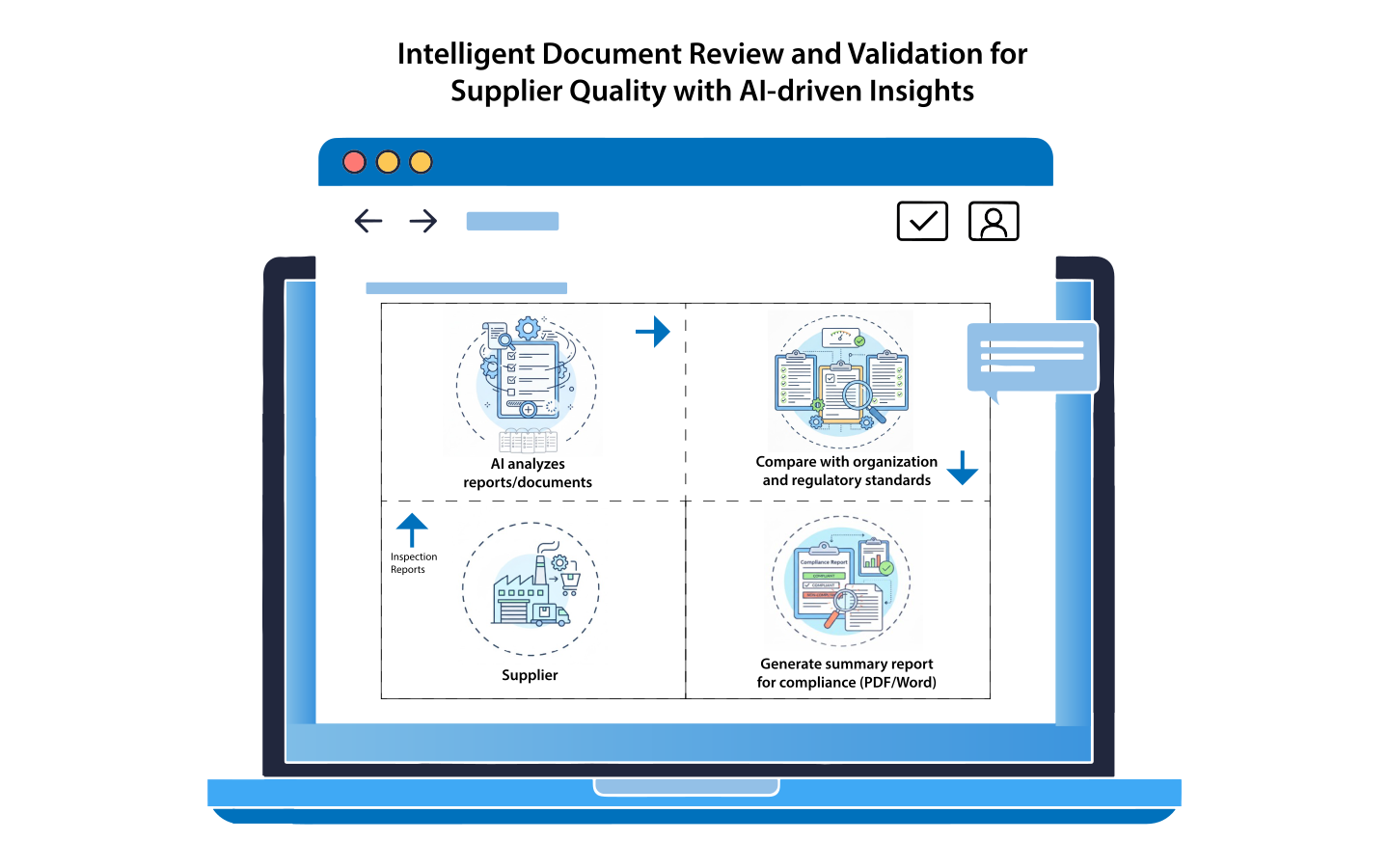
 Intelligent document review & validation
AI-led visual quality inspection helps mitigate challenges such as complex product design, high defect escape rate, large number of variants, high cost of rework, and space constraints.
Modular agents embedded across the end-to-end SQA audit workflow, generating dynamic check list, guiding, validating, and accelerating auditor actions at every stage.
We use AI to analyze inspection reports and documents received from suppliers, compares them against applicable organizational and regulatory standards, and generates a concise summaries highlighting compliance and non-compliance with relevant specifications.
Consistency across outcomes
We help you achieve better quality with less effort. Standardized processes and automation reduce costs, speed up workflows, and catch defects early. Strong supplier management and inspections ensure reliable, high-quality output every time.

Customer successes
Provided supplier quality assurance support.
Key benefits:- Accelerated on-time equipment deliveries through immediate replacement of rejections.
- Reduced rejections to an all-time low by timely initiation, validation, and closure of CA/PA plans.
- Arrested revenue leakage by closely monitoring and executing penalties for rejections and delays in CA/PA plan implementation, ensuring compliance with quality policies.
Performed process failure mode and effects analysis (PEMA).
Key benefits:- Implemented a proactive risk identification system, improving early issue resolution.
- Decreased process failure likelihood through effective risk management and adherence to quality objectives.
- Reduced costs and enhanced product quality, reliability, and safety.
- Established a structured process for identifying concerns.
Success Stories
Bringing values to businesses through our products and services


Challenges & solutions : Quality management services
The cost of poor quality falls when defects are caught earlier and processes stop varying between sites and shifts. A digital quality management system standardises inspection, supplier quality, and corrective action so problems are detected at incoming and in-process stages rather than at the customer. Automated data capture and analytics surface the recurring root causes behind scrap, rework, and warranty claims, so they are eliminated rather than repeatedly fixed. Consistent CAPA and SCAR workflows shorten the time from detection to resolution. Supplier quality management reduces defects entering the line in the first place. For a manufacturing operations leader, the result is lower scrap and rework, fewer escapes, and quality cost that trends down as the same disciplined processes run across the plant network, reflecting a strong commitment to quality.
The trigger is usually when quality demands outgrow internal capacity or consistency across sites breaks down, highlighting the need for a comprehensive quality system. Manufacturers reach this point when inspection volumes spike, supplier networks expand, audit and compliance burdens rise, or when moving from manual checks to AI-led inspection needs skills and tools they do not have in house. Multi-plant operations that need uniform quality processes, and those under heavy regulatory or customer-audit pressure, benefit most. Quality management outsourcing brings trained inspectors, standardised processes, and analytics without the cost of building and staffing the capability internally. The plant retains ownership of quality strategy and engineering judgement; the partner runs the execution engine consistently and at scale, closing a capacity and consistency gap rather than replacing the internal quality function.
The strongest partners combine manufacturing quality depth with mature automation, a clear managed-services model, and adherence to ISO 9001 quality standards. Look for end-to-end coverage across the quality value chain: quality planning, inspection management, supplier quality, CAPA and SCAR, and quality analytics, so quality is not fragmented across vendors. Assess how they apply AI to visual inspection and supplier audits, how they integrate with your existing QMS or ERP, and the strength of their compliance and certification support. Ask for evidence of outcomes such as reduced cost of quality, faster corrective action, and improved supplier performance, and for experience in your industry and regulatory environment. Governance, audit-readiness, and the ability to scale across plants matter. The right partner strengthens quality while working alongside your engineering teams.
Compliance and audit readiness depend on consistent, documented processes with traceable evidence. A managed quality management system runs inspection, non-conformance, and corrective-action workflows to standardised procedures, so every check, deviation, and resolution is recorded and retrievable. Document review and validation keep specifications, certificates, and records current and controlled. Supplier quality management extends the same rigour to incoming materials, reducing the compliance risk that enters from the supply chain. Because the same processes run across sites, evidence for customer audits, certification bodies, and regulators is easier to assemble and defend. For a quality or compliance leader, adherence becomes a by-product of how quality operations run day to day, rather than a separate effort assembled ahead of each audit cycle.
AI is shifting quality management from manual, after-the-fact inspection toward real-time detection and prevention, significantly enhancing quality policies. Machine-learning visual inspection identifies defects faster and more consistently than manual checks, especially across high-variant, complex products, thus improving customer satisfaction. AI agents support supplier quality audits, and intelligent document review validates records and specifications at scale. Analytics predict where defects are likely to occur so effort moves upstream. Infosys BPM applies the Topaz AI framework within managed quality management services, so these capabilities reach the plant as fewer escapes, faster corrective action, and lower quality cost rather than as systems the manufacturer must build and run. Engineering and safety judgement stays with the quality team; AI sharpens detection and removes manual effort.
Request for services
Find out more about how we can help your organization navigate its next. Let us know your areas of interest so that we can serve you better.

All the fields marked with * are required

