







Responsible AI services
Artificial intelligence (AI) is now deeply integrated across industries and everyday life, driving innovation, automating processes, and shaping decisions at scale, while adhering to responsible AI principles. While this rapid adoption of generative AI brings immense opportunities, it also poses significant risks that need careful deployment. Without responsible design and robust safety mechanisms, AI can amplify harmful content, spread misinformation, perpetuate bias, and compromise privacy. In high-stakes environments, opaque or unpredictable AI behavior can lead to severe consequences for individuals and organizations alike.
Infosys BPM’s responsible AI (RAI) framework transforms these challenges into opportunities for trust and safety. By embedding principles of fairness, accountability, and transparency into AI systems, RAI ensures that algorithms behave predictably, ethically, and in alignment with societal values. These guardrails make AI not only powerful but also trustworthy, creating a foundation for sustainable innovation.

Key stats
100+ AI experts
38+ Global delivery centers
30+ Global clients in AI trust & safety

Our solutions in responsible AI
According to a KPMG Global Study, 66% of people use AI regularly, yet only 46% trust these systems, and 70% believe stronger regulations are necessary to ensure safety and accountability in AI initiatives. Privacy concerns remain significant, with just 47% of respondents confident that AI companies adequately protect personal data, as highlighted in the Stanford AI Index. Responsible AI is the foundation for building trust with users, stakeholders, and society at large, making AI not just intelligent, but safe, ethical, and accountable through effective oversight.
AI safety services required while building customer facing solution
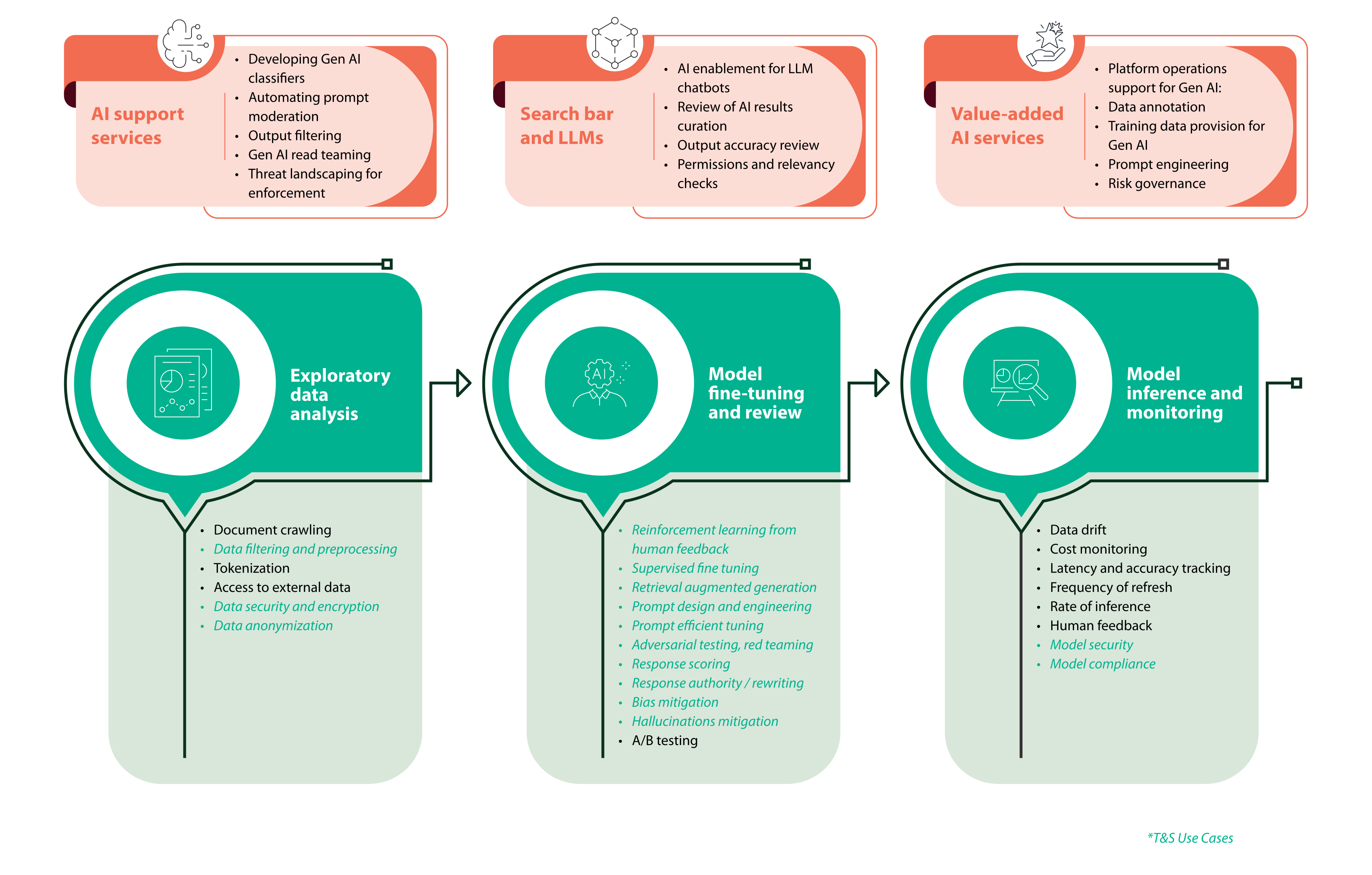
AI safety solutions
| Area | Topics | Challenges | Solutions |
| Exploratory data analysis | Privacy guardrails:
|
|
|
| Model fine-tuning and review |
|
|
|
| Model inference and monitoring |
|
|
|
 Red teaming
 AI tools and platforms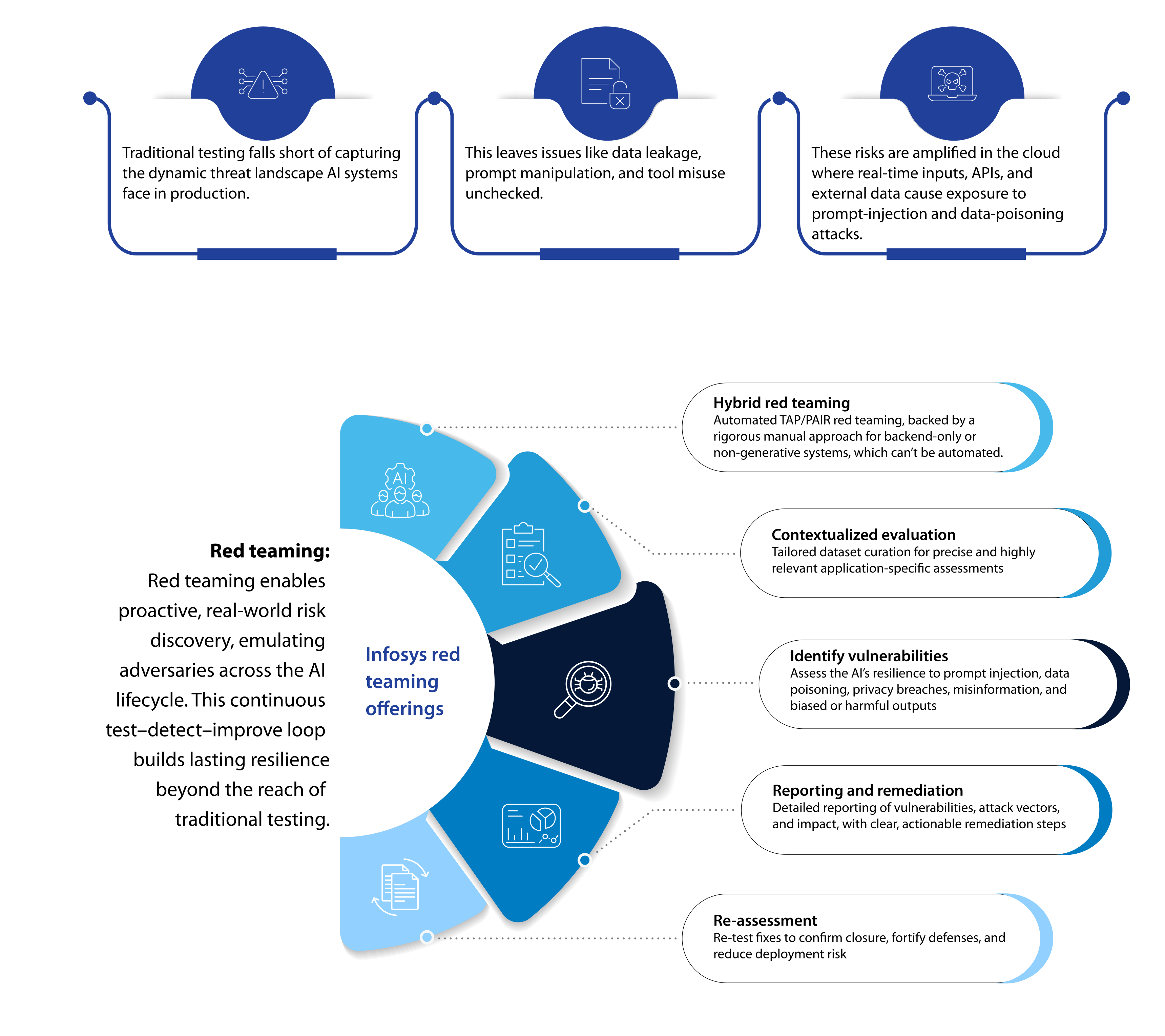

RAI
The responsible AI suite consists of 10+ offerings built on the scan, shield, and steer (AI3S) framework.

Counterfeit detection solution
Our AI-powered counterfeit detection leverages computer vision and machine learning to identify fake products by analyzing images and serial numbers.

Image moderation solution
The image moderation tool ensures that product images and digital content meet quality, compliance, and brand standards across platforms.

Leap BizOps
Intelligent business management platform with AI/ML capabilities. Enables intelligent, automated, and autonomous ops.

Compliance & controls testing automation platform
AI-powered audit and compliance tools for anomaly detection and compliance monitoring.

Infosys AI / ML for fraud detection
Strategic combination of domain expertise, analytical skills, and advanced AI/ML technologies to deliver robust fraud detection solutions.

Behavioral biometrics
Behavioral biometrics leverages AI models to monitor and analyze unique user behavior patterns. When deviations from this baseline occur, it may indicate:
- Fraudulent activity
- Account takeovers
- Bot interactions
Why Infosys BPM for responsible AI
Enterprises choose Infosys to build and scale responsible AI (RAI) because we operationalize trust across the AI lifecycle with a strong governance framework. Our Scan–Shield–Steer framework, EU AI Act & NIST AI RMF alignment, and open source Responsible AI toolkit deliver guardrails, governance, and audit ready evidence for GenAI and Agentic AI. With deep ecosystem partnerships and proven delivery, we help you launch AI faster, by being secure, fair, explainable, and compliant by design.
- End-to-end RAI operating model, “Scan–Shield–Steer” to map risks and obligations, embed technical guardrails, and orchestrate governance mechanisms.
- Infosys is the world’s first IT services organization to achieve ISO/IEC 42001:2023 certification, the international standard for Artificial Intelligence Management Systems (AIMS).
- Regulatory ready by design (EU AI Act, NIST AI RMF, ISO/IEC 42001)
- Open source responsible AI toolkit (faster, transparent guardrails)
- First class integration with major hyper-scalers, and governance overlays (e.g., Watsonx.governance)
- Red teaming & agentic AI risk mitigation: We apply threat modeling, automated/adversarial testing, and agent policy sandboxes to stress test LLMs and AI agents
- Always on market & regulatory intelligence, monitoring new laws, incidents and vulnerabilities
- Recognitions & thought leadership: Infosys was honored with The Economic Times Responsible & Ethical AI Leadership Award, validating our industry leadership and commitment to building trustworthy AI ecosystems.
- We pair ethics with quality, robustness, and observability, so AI remains reliable and repeatable in production.
Insights




Success stories
Bringing values to businesses through our products and services

Case Study

Case Study

Case Study

Challenges & solutions - responsible AI services
AI red teaming validates resilience by deliberately attacking a model the way a real adversary would, then fixing what breaks. Structured tests probe for prompt injection, jailbreaks, data leakage, bias, and unsafe outputs across the model lifecycle, not just at launch. Findings feed a continuous detect-improve loop, with re-assessment after remediation. Because AI risks amplify in production, resilience is validated through hybrid automated and human red teaming, contextual evaluation, and ongoing monitoring rather than one-time pre-release testing.
Evaluate depth across the full AI lifecycle: governance, risk assessment, red teaming, and ongoing monitoring, not just policy documents. Look for alignment to recognised frameworks such as the EU AI Act, NIST AI RMF, and ISO/IEC 42001, and for evidence of certification rather than intent. Assess whether the partner can operationalise guardrails for GenAI and agentic AI, provide audit-ready evidence, and embed governance into delivery. The strongest partners combine framework alignment, red-teaming capability, and proven governance, so responsible AI is demonstrable, not aspirational.
They translate regulatory requirements into operational controls. Governance frameworks map obligations from the EU AI Act and NIST AI RMF to concrete guardrails, documentation, and audit evidence across the AI lifecycle. Risk assessment classifies systems by risk tier, red teaming tests for the harms regulators care about, and monitoring maintains ongoing conformance as models and rules change. ISO/IEC 42001 certification provides an auditable management-system backbone, so compliance is continuous and defensible rather than a point-in-time exercise.
They address the risks that scale with GenAI: harmful or biased content, misinformation, prompt injection and jailbreaks, data leakage and privacy exposure, hallucination, and model drift over time. For agentic AI, they add controls around autonomous actions and unintended reach. Governance sets the policies and accountability, risk assessment prioritises exposure, red teaming stress-tests the system, and monitoring catches drift and new vulnerabilities in production, so risks are managed across the lifecycle rather than at a single checkpoint.
Traditional testing checks whether software behaves as specified against known cases. AI red teaming assumes intelligent adversaries and probes for behaviours no one specified: prompt injection, jailbreaks, data extraction, bias, and emergent unsafe outputs. Because AI systems are probabilistic and risks amplify in cloud and production settings, red teaming is continuous and lifecycle-wide, combining automated attacks with human creativity, followed by remediation and re-assessment, rather than a fixed pass-fail suite run before release.
Before deploying AI in any high-stakes or customer-facing setting, not after an incident. The trigger is usually the first move from experimentation to production, or the point where regulation, board scrutiny, or customer trust require demonstrable controls. Organisations building GenAI or agentic systems, operating in regulated markets, or scaling AI across functions need governance, risk assessment, red teaming, and monitoring in place by design, so responsible AI is built into the system rather than retrofitted under pressure.
Request for services
Find out more about how we can help your organization navigate its next. Let us know your areas of interest so that we can serve you better.

All the fields marked with * are required

